
How to Transform Your Content Strategy with an AI-Powered SEO Platform
Learn to build a transformative AI-powered SEO content strategy using a full platform. Go beyond simple AI writers to automate audits, planning, and content creation.
An AI-powered SEO content strategy is a comprehensive approach to planning, creating, optimizing, and measuring content that uses artificial intelligence at every step to make data-driven decisions, automate repetitive tasks, and scale the production of content engineered to rank and drive business goals. It moves the human role from being a line-level content producer to a high-level system manager and strategist who oversees the entire AI-driven content engine.
The fundamental relationship between businesses and search engines is changing. Traditional SEO, a game of climbing a list of ten blue links, is being systematically replaced by a new paradigm: optimizing for AI-powered answer engines. Platforms like Google’s AI Overviews, ChatGPT, and Perplexity now act as direct information synthesizers, collapsing the traditional marketing funnel. A single, conversational query can guide a user from initial awareness to a final purchase decision, often without a single click to a third-party website. This shift renders old playbooks obsolete and presents an existential threat to businesses reliant on organic traffic.
Most marketers are still experimenting with AI as a magical typewriter—a tool to write articles faster. This approach dramatically misses the larger opportunity. The real transformation comes from deploying a full AI-powered SEO platform to automate and optimize the entire content lifecycle. This guide provides a step-by-step framework for moving beyond simple automated content creation and implementing a true, data-driven AI-powered SEO content strategy that builds authority, drives traffic, and captures revenue in the age of AI search.
Building Your AI-Powered SEO Tech Stack
To successfully implement an AI-driven content strategy, you must assemble the right tools and adopt a new operational mindset. This foundation ensures you can leverage AI for strategic decision-making rather than just tactical execution, setting the stage for scalable and sustainable growth.
Essential Tools
Before beginning, ensure you have access to a core set of platforms that will work in concert. While a powerful AI SEO platform is central, it integrates with foundational analytics tools to create a complete feedback loop for measuring real-world impact.
| Tool Category | Detail | Takeaway |
|---|---|---|
| AI SEO Platform | Core Engine | This is the non-negotiable command center. A true automation platform handles the entire workflow from competitive analysis and roadmap generation to content creation, optimization, and publication. |
| Performance Analytics | Google Search Console & GA4 | GSC provides direct-from-Google data on clicks and impressions, while GA4 reveals post-click user behavior and conversions. This data is vital for validating the AI's strategic direction and proving ROI. |
| Project Management | Asana, Trello, etc. | These tools are essential for managing the human-in-the-loop review processes, ensuring AI-generated drafts are efficiently passed to, reviewed by, and approved by subject matter experts (SMEs). |
The Necessary Mindset Shift
The most significant prerequisite isn't a tool but a change in perspective. Success with content automation requires leaders and their teams to fundamentally evolve their roles.
- From Content Creator to Strategy Overseer: Your primary job is no longer to write and edit every word. It's to define strategic goals, set parameters for the AI, review the AI's proposed roadmap, and ensure the final output aligns with your brand's unique expertise. You guide the machine, not operate the keyboard.
- Embracing a Data-First Approach: AI-driven strategy is built on massive datasets, not gut feelings. You must learn to trust the patterns and opportunities the AI uncovers in competitor performance and SERP data, even when they challenge your long-held assumptions.
- From Individual Articles to Content Ecosystems: Stop thinking about content as a series of one-off blog posts. An AI-powered strategy focuses on building comprehensive topic clusters—interconnected networks of content that establish the topical authority that AI answer engines look for.
- Willingness to Test and Iterate: Treat your content strategy as a living system. The strategist's role is to analyze the results and use that data to refine the inputs for the next cycle, creating a continuous improvement loop.
Step 1: Conduct an AI-Powered Audit of Your Existing Content Ecosystem
This initial step uses AI to create a data-backed baseline of your current performance, identifying weaknesses and opportunities before you build your new strategy. Instead of spending weeks manually sifting through spreadsheets, an AI platform can produce a comprehensive audit in minutes.
Use AI to Benchmark Your Topical Authority
An AI platform automatically connects to your domain, crawling your existing content to map your current topical authority and identify critical content gaps. It analyzes how your articles are clustered around core business topics, scoring your expertise and revealing which areas are strong, which are thin, and which are missing entirely. This process moves beyond single-keyword rankings to assess your overall relevance in your niche—a critical factor for being cited by AI answer engines.
For example, the output might be a visual, color-coded topic map showing a "strong" green cluster around "email marketing software" but a "missing" red area for "sales funnel optimization." This immediately tells you where your strategic focus should be. The audit should also flag "striking distance" opportunities—pages ranking on the second or third page of Google that can be pushed to page one with a strategic update.
Automate Your Competitive Content Gap Analysis
AI-driven competitive analysis automates the laborious process of identifying high-value topics your competitors rank for that you have not yet covered. Simply input the domains of 3-5 key competitors, and the AI platform will crawl their content, analyze their rankings, and cross-reference them against your own content map.
The output is not a raw data dump but a prioritized list of strategic content ideas, often presented like this:
- Gap: "B2B SaaS Pricing Models"
- Competitors Ranking: CompetitorA.com (Position #2), CompetitorB.com (Position #4)
- Estimated Traffic Value: 1,200 monthly visits
- Your Coverage: None
- Recommendation: Prioritize this topic cluster.
This data-driven approach eliminates guesswork from your content planning, ensuring your roadmap is laser-focused on capturing market share.
Step 2: Build Your Strategic Content Roadmap with AI
A strategic content roadmap built with AI uses predictive analytics and automated keyword clustering to create a full-funnel content calendar that targets user intent and builds topical authority for answer engines. This step transitions you from a reactive content creator to a proactive strategist.
What Are AI SEO Strategies?
AI SEO strategies are comprehensive content plans that leverage artificial intelligence to analyze massive datasets, predict topic performance, and build a roadmap designed to achieve topical authority. Instead of targeting single keywords, they focus on building interconnected ecosystems of content.
The core principle is topical authority. By creating clusters of articles that comprehensively cover a subject, you signal to search engines and Large Language Models (LLMs) that your website is an authoritative source. When an AI like Google's AI Overviews needs to synthesize an answer, it is far more likely to trust and cite a domain that has demonstrated deep expertise.

Source: amazon.com
Use AI for Advanced Keyword Research and Clustering
An AI platform automates keyword research by generating thousands of relevant terms from a few seed topics and then automatically grouping them into semantic clusters. You provide the system with a handful of high-level topics, and the AI explores search data, forums, and competitor content to find long-tail keywords and user questions.
Crucially, the platform uses Natural Language Processing (NLP) to organize these keywords into clusters centered on a core "pillar" topic and multiple "spoke" subtopics.
- Pillar Topic: "Best project management software for small teams"
- Spoke Topics: "Asana vs. Trello comparison," "How to create a project timeline," "Free project management tools," "Benefits of Gantt charts."
This cluster-based model is the architectural foundation for building topical authority.
Generate a Full-Funnel Content Calendar Automatically
Based on the audit and keyword clustering, a full SEO platform can generate a multi-month content calendar that addresses every stage of the buyer's journey. The AI prioritizes the identified content gaps and keyword clusters, scheduling them into a logical publication sequence.
A well-formed, AI-generated calendar will include a strategic mix of content formats:
- Top-of-Funnel (ToFu): Informational blog posts and guides to build awareness (e.g., "What is agile project management?").
- Middle-of-Funnel (MoFu): Comparison articles and case studies to help users evaluate options (e.g., "Smartsheet vs. Monday.com").
- Bottom-of-Funnel (BoFu): Product-led content and buying guides to drive conversions (e.g., "How to integrate [Your Software] with Slack").
This automated process ensures your content production is a calculated effort to engage users at every touchpoint.
Step 3: Scale High-Quality Content Production with AI
With a data-driven roadmap in place, you can leverage AI writing assistants to dramatically accelerate content creation while ensuring every article is optimized for search from the first draft. This step marries machine speed with human expertise.
The Human-in-the-Loop: Marrying AI Speed with Human Expertise
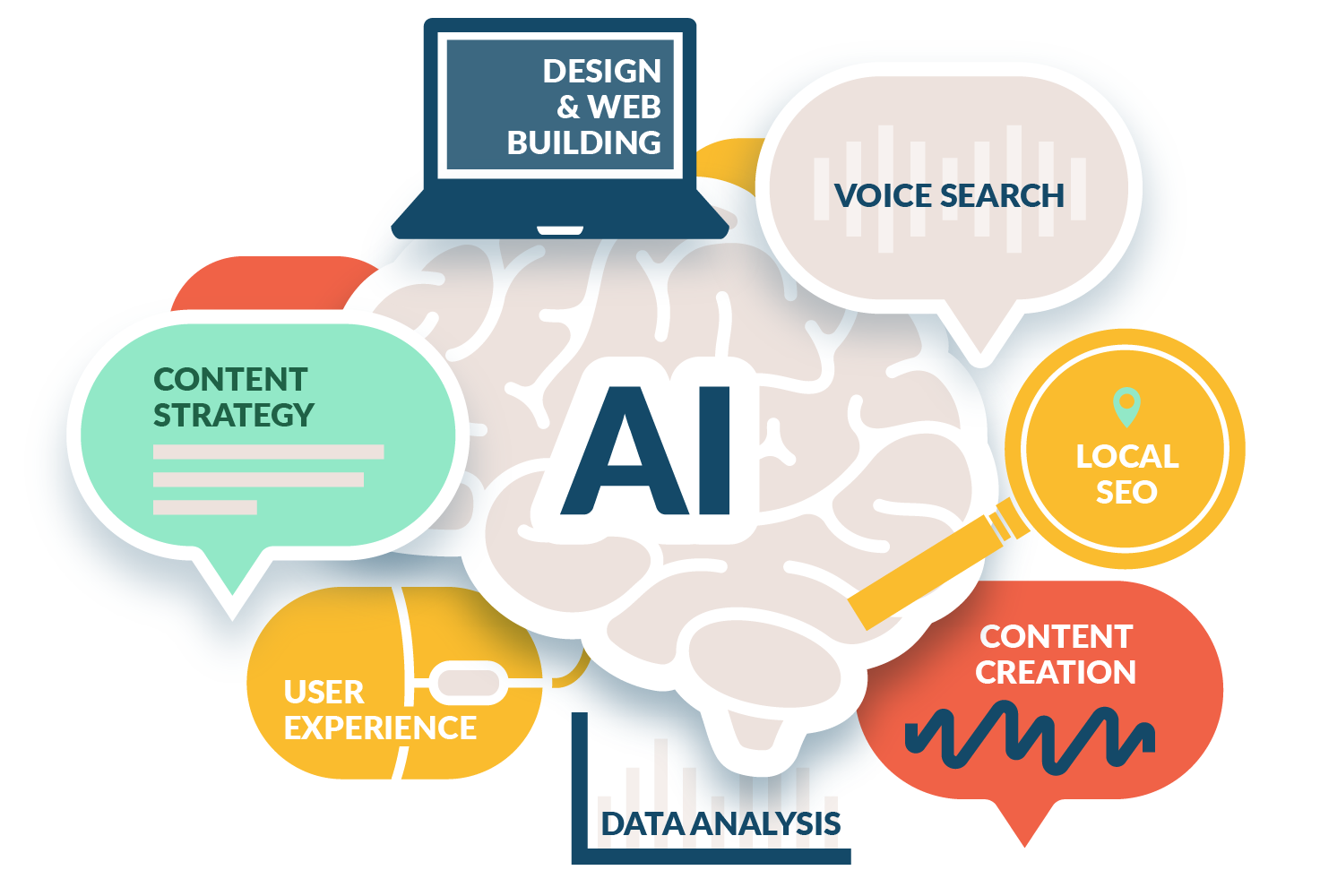
A successful AI-powered content workflow blends AI generation with human oversight to maximize both efficiency and quality. This hybrid approach is essential for creating content that is factually accurate, reflects your brand's voice, and demonstrates genuine experience—all critical components of Google's E-E-A-T guidelines.
Source: metricmarketing.com
- First Draft Generation: Use the platform's AI to generate a comprehensive first draft based on the detailed topic brief from your roadmap. This brief includes the target keyword cluster, user intent analysis, and a recommended structure derived from top SERP results.
- Human Review & Expertise Injection: Your in-house subject matter expert (SME) reviews the AI-generated draft. This is the most critical value-add step. The SME's job is not to rewrite the entire piece but to infuse it with things an AI cannot: unique insights, first-hand experiences, proprietary data, or a quote from an internal expert. This is how you add the "Experience" to E-E-A-T.
- AI-Powered Optimization and Polish: After the SME has added their expertise, run the draft back through the AI optimization tool. This final pass acts as a quality assurance check, fine-tuning on-page SEO elements, ensuring optimal keyword density, and confirming perfect alignment with the data-driven brief.
Performing AI-Powered SEO Optimization
AI-powered SEO optimization is the process of using an AI platform to analyze your draft against the top-ranking pages for your target query and receive real-time recommendations to improve its ranking potential. The platform provides a live optimization score based on dozens of factors.
This includes data-backed suggestions for:
- Optimal word count and heading structure (H1, H2s, H3s).
- Inclusion of LSI (Latent Semantic Indexing) keywords and related entities.
- Analysis of SERP features (e.g., recommending an FAQ section if the SERP has a People Also Ask box).
- Identification of internal and external linking opportunities.
- Generation of optimized meta titles and descriptions.
Step 4: Automate On-Page SEO and Site Architecture
An advanced AI SEO platform moves beyond content creation to automate the technical on-page optimizations and internal linking structures that signal authority to search engines. This automates some of the most tedious and critical SEO tasks.
Automatically Generate and Optimize Metadata
Let the AI platform generate multiple compelling, keyword-rich meta titles and descriptions for each new article. A sophisticated system can analyze the SERPs to identify patterns in titles and descriptions that earn the highest click-through rates (CTR). The AI can also automatically generate other elements like image alt text and schema markup (like FAQPage schema) to help your content stand out.
Build a Powerful Internal Linking Structure with AI
As you publish new content, a true AI SEO platform automatically scans your entire library of existing articles to find relevant, contextually appropriate opportunities for internal links. This solves one of the most significant and often neglected challenges in SEO.
The AI uses NLP to understand the semantic relationships between your pages. When a new article on "running shoe cushioning" is published, the system will automatically identify older posts on "best running shoes for flat feet" and suggest adding a link with optimized anchor text. This process ensures new posts inherit authority from established pages and helps search crawlers understand the logical structure of your site, boosting the authority of the entire topic cluster.
Step 5: Measure, Iterate, and Scale Your Strategy
An AI-powered SEO content strategy is a dynamic system that improves over time; use AI to analyze performance data and turn those insights into your next strategic moves. This final step closes the loop, transforming your content program into a self-learning engine.
Use AI for Performance Tracking and Content Decay Alerts
Configure your AI platform to continuously monitor the search rankings and organic traffic for all your published content, integrated with your Google Search Console data. The system should automatically alert you when an article starts to lose its position or traffic—a phenomenon known as "content decay."
These alerts are your cue to act. The AI can then assist in the content refresh process by re-analyzing the current top-ranking pages and suggesting specific updates—like adding a new section or updating statistics—to help you reclaim your spot.
Create a Predictive Feedback Loop for Your Content
Analyze performance data to see which AI-generated topic clusters are driving the most traffic and conversions, then feed those insights back into the AI to inform your next content roadmap. For example, if your analytics dashboard reveals that "Middle-of-Funnel" comparison articles are driving the most demo sign-ups, you can use this insight to create a new directive for the AI: "Prioritize the generation of all remaining MoFu content clusters." This creates a virtuous cycle where your strategy becomes more precise and profitable with each iteration.
Optimizing for the Future: AI Overviews and Answer Engines
The steps outlined above are not just for climbing traditional search rankings; they are foundational for success in the new era of "Answer Engine Optimization." AI-driven search features like Google's AI Overviews and platforms like ChatGPT function by synthesizing information from multiple trusted sources to provide a direct answer.
Your goal is to become one of those trusted sources.
An AI-powered SEO strategy is uniquely suited for this challenge because it focuses on the same signals that generative AI models use to determine authority:
- Topical Completeness: By building comprehensive topic clusters, you demonstrate a depth of knowledge that isolated articles cannot. An answer engine is more likely to cite a source that has covered a topic from every angle.
- Structured Data: AI-generated schema markup (like FAQs and How-To) makes your content easily digestible for machines, increasing the likelihood that your information will be used to populate an AI-generated answer.
- E-E-A-T Signals: The human-in-the-loop workflow ensures your content contains unique insights and real-world experience, which Google has explicitly stated is important for its AI-powered results.
By focusing your strategy on building a verifiable, interconnected library of expertise, you are future-proofing your content against algorithm changes and positioning your brand as an authority worth citing in the zero-click search landscape.
Comparing AI Writers vs. Full AI SEO Platforms
It is crucial to understand that a standalone AI writing tool is fundamentally different from a comprehensive strategic platform that manages the entire content lifecycle. The former is a tactic; the latter is an operating system for content marketing.
Think of it this way: a standalone AI writer is like a freelance chef. You can give them a recipe (a keyword), and they'll cook you a decent meal (an article). A full AI SEO platform is like being the executive chef of a restaurant. It designs the entire menu (content roadmap), sources the ingredients (data analysis), automates the kitchen (writing & optimization), and analyzes sales data (performance tracking) to inform future menu development.
| Feature | Standalone AI Writer | Full AI SEO Platform |
|---|---|---|
| Primary Function | Generates text for a single article based on a prompt. | Manages the entire content lifecycle, from audit to measurement. |
| Strategy | Relies 100% on human input for all strategic decisions. | Automates competitive analysis and builds a data-driven content roadmap. |
| Keyword Research | Provides basic keyword suggestions for one document. | Performs advanced keyword clustering across your entire niche. |
| Internal Linking | No capability. It is unaware of your other content. | Provides automated suggestions based on site-wide semantic relevance. |
| Performance | No tracking or measurement capabilities. | Monitors rankings, alerts on content decay, and provides strategic insights. |
| Best For | Quickly drafting a single, isolated blog post. | Building and scaling a long-term, authoritative content program. |
Natiad is an AI SEO platform that puts a website's content marketing on autopilot using AI agents. It analyzes a site, creates a content roadmap, writes SEO-optimized articles, and automatically publishes them with internal links to drive traffic and revenue from search engines and AI assistants. Explore more at https://natiad.com.
Frequently Asked Questions (FAQ)
What is an AI-powered content strategy?
An ai powered content strategy is a comprehensive approach to planning, creating, optimizing, and measuring content that uses artificial intelligence at every step. It makes data-driven decisions, automates repetitive tasks, and scales the production of content engineered to rank in both traditional and AI-driven search results.
How does AI impact an SEO content strategist's role?
AI elevates the role from task-execution to high-level strategy, which can significantly increase earning potential. Strategists who leverage AI platforms focus on interpreting data, refining brand voice, and making executive decisions about which content clusters to prioritize. They develop new skills in prompt engineering, AI workflow management, and data interpretation, making them more valuable by allowing them to oversee a much larger and more effective content program.
Is AI-generated content good for SEO?
Google's official stance is that high-quality, helpful content is rewarded, regardless of how it is produced. Therefore, AI-generated content is good for SEO when it is accurate, people-first, and demonstrates high levels of E-E-A-T (Experience, Expertise, Authoritativeness, Trust). The key is using AI as a tool to assist human experts, not as a cheap replacement. Content generated purely to manipulate rankings without human oversight or added value will likely fail.
What are the biggest risks or limitations of an AI-powered content strategy?
The primary risks are over-reliance on automation, factual inaccuracies, and loss of brand voice. Without a robust human-in-the-loop review process, AI can produce generic or incorrect information. A successful strategy requires human oversight to inject unique expertise (E-E-A-T), verify facts, and ensure the final content aligns with the brand's unique perspective and tone.
How do you find the best AI SEO writer?
The best AI SEO writer is typically not a standalone tool but an integrated feature within a complete SEO platform. A great AI writer needs data and context to be effective. When evaluating tools, look for one that connects keyword data, competitive analysis, and real-time optimization suggestions directly into the writing interface. This ensures the content is created with a clear strategic purpose from the very beginning.