
NeuronWriter vs. Natiad: Is On-Page Optimization or Full Automation a Better Investment?
Choosing between NeuronWriter content optimisation and full automation? We compare NeuronWriter vs. Natiad to see if a tool or a system is a better investment.
Optimizing content for search engines has evolved from simple keyword stuffing into a sophisticated science. To rank highly, modern content must satisfy search intent, cover topics comprehensively, and align with the signals Google's NLP algorithms look for. This is where AI-powered content optimization tools come in.
NeuronWriter is a leading platform in this space, designed to give content creators a data-driven blueprint for ranking. It analyzes top-performing pages and provides a real-time editor to guide your writing process. This article provides a deep dive into NeuronWriter's content optimisation features, a step-by-step guide on how to use it, and a look at how it compares to both direct competitors and the alternative philosophy of full content automation.
What is NeuronWriter? A Co-Pilot for SEO Content
NeuronWriter is an AI-powered content optimization tool that uses SERP analysis and Natural Language Processing (NLP) to provide writers with data-driven recommendations. It acts as an assistant, offering a real-time editor to score and improve a single piece of content.
NeuronWriter operates as a powerful co-pilot for content creators, SEOs, and marketers. Its primary function is to deconstruct the top-ranking search results for a target keyword and turn that analysis into an actionable blueprint for your own article. Instead of guessing what Google’s algorithm and user expectations demand, it provides a clear, data-driven checklist. This includes semantically related terms, a recommended structure based on competitor outlines, target word counts, and readability scores.
The core of the NeuronWriter experience is its advanced content editor. As you write or paste in a draft, a content score from 0-100 updates in real-time, visually representing how well your article covers the topic compared to the competition you selected. This gamified process pushes writers to create more comprehensive and contextually rich content. It's meticulously designed to help a human writer produce a single, perfectly optimized article that satisfies both search intent and Google's complex ranking systems.
| Feature Area | Detail | Key Takeaway |
|---|---|---|
| Core Technology | Uses Natural Language Processing (NLP) and SERP analysis to extract entities, topics, and common questions from top-ranking pages. | Provides a data-backed recipe for what to include in your content. |
| Content Scoring | Provides a real-time, gamified score (0-100) to measure semantic optimization against selected competitors. | Turns optimization into an interactive and measurable process. |
| AI Assistance | Integrates GPT-4 for generating drafts, rephrasing sentences, expanding on ideas, and creating elements like FAQs or meta descriptions. | Accelerates the manual writing process and helps overcome writer's block. |
| Competitor Analysis | Leverages Moz data (DA, PA) and other metrics to help you select the most relevant competitors for your content blueprint. | Ensures you are modeling your content against the most relevant, high-performing articles. |
| Integrations | Connects with Google Search Console to identify content decay, find new opportunities, and prioritize content refreshes. | Bridges the gap between content creation and performance analysis. |
A Deep Dive into NeuronWriter's Core Optimisation Features
NeuronWriter packs a suite of tools designed to guide every stage of the on-page optimization process, from initial research to final polishing.
SERP Analysis and Data-Driven Briefs
The NeuronWriter content plan is a detailed, single-article brief that includes a recommended structure, target word count, H1/H2 suggestions, and a list of NLP-derived keywords. It serves as a comprehensive guide for writing one highly-optimized piece of content.
Before you write a single word, NeuronWriter does the heavy lifting. It analyzes the top Google results for your keyword and synthesizes that data into a "Content Brief." This blueprint front-loads the research phase, allowing the writer to focus purely on crafting high-quality prose. A typical brief includes:
- Competitor Structure: A breakdown of the H1, H2, and H3 tags used by top-ranking articles, allowing you to build a superior outline.
- Questions to Answer: A list of relevant questions pulled from Google's "People Also Ask" boxes, Quora, and competitor headings.
- NLP Term List: The full list of basic and extended keywords to include in your text and headings.
- Content & Quality Metrics: Data-driven targets for word count, heading count, and readability score based on competitor averages.
The Real-Time Content Editor and NLP Scoring
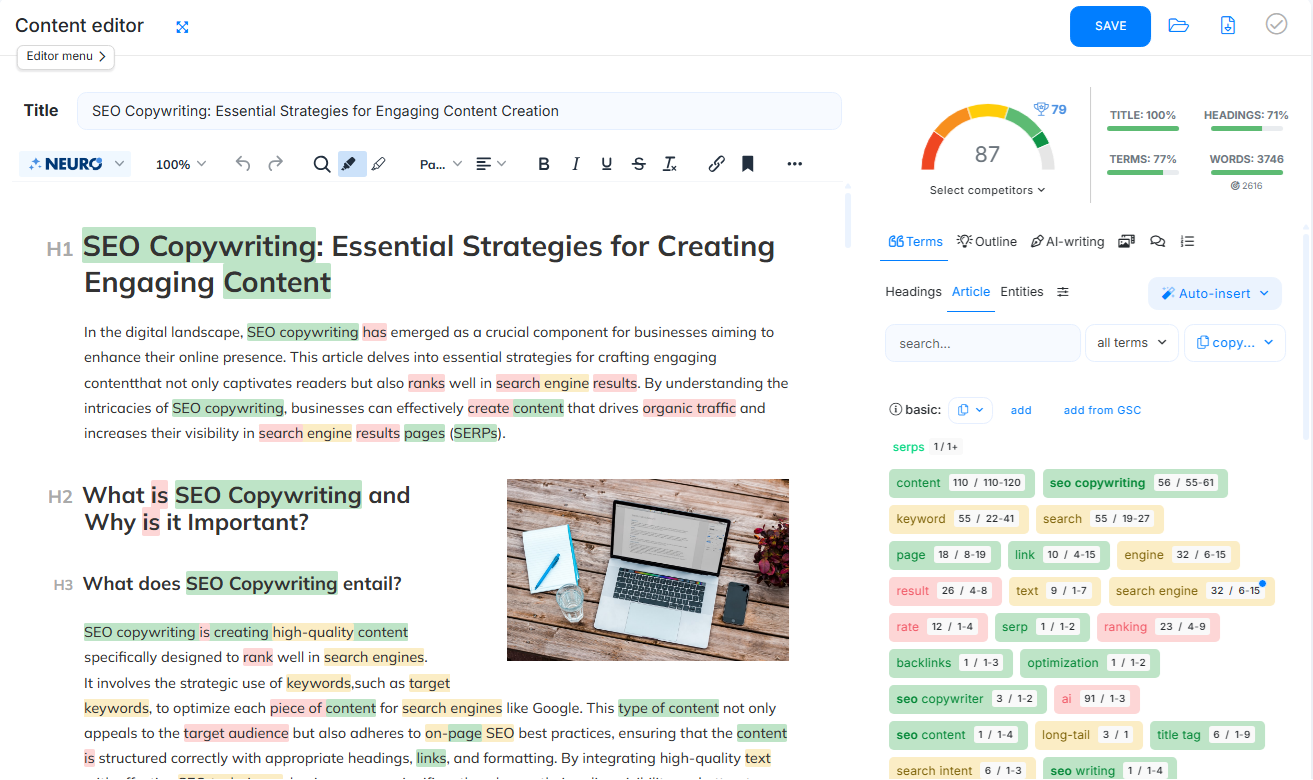
NeuronWriter's NLP (Natural Language Processing) engine works by analyzing the top-ranking pages for a keyword to extract key semantic terms and entities. This data is then used to create a data-driven blueprint for your content to follow.
Source: NeuronWriter
The editor is where the magic happens. As you write, a sidebar tracks your progress, updating your Content Score in real-time. It highlights which NLP terms you've used and which you still need to include. This immediate feedback loop turns writing into a more scientific process.
For a query like "how to train for a marathon," its NLP might identify essential terms like:
- Basic Terms:
running plan,long runs,race day,miles per week - Extended Terms:
tapering,nutrition,hydration,cross-training,injury prevention,carb-loading
By including these terms naturally, you signal to Google that your content is comprehensive and covers the topic in the depth that users expect.
AI Writing Assistant
NeuronWriter functions as an AI SEO writing assistant by offering features to generate paragraphs, expand on ideas, and rephrase sentences. This helps writers overcome blocks and integrate necessary keywords more naturally without writing everything from scratch.
Within its editor, you can use AI credits to access a variety of templates. This isn't full automation; it's AI-assisted writing that accelerates the manual process. Common uses include:
- One-Click Article Generation: Creates a full first draft based on your outline, which you then edit and refine.
- Paragraph Expansion: Takes a heading or a short sentence and fleshes it out into a full paragraph.
- FAQ with Unused Terms: A powerful feature that generates relevant questions and naturally incorporates NLP terms you haven't used yet.
- Meta Description & Title Generation: Creates SEO-friendly titles and descriptions based on your content, similar to a dedicated meta description generator.
How to Optimise an Article with NeuronWriter: A Step-by-Step Guide
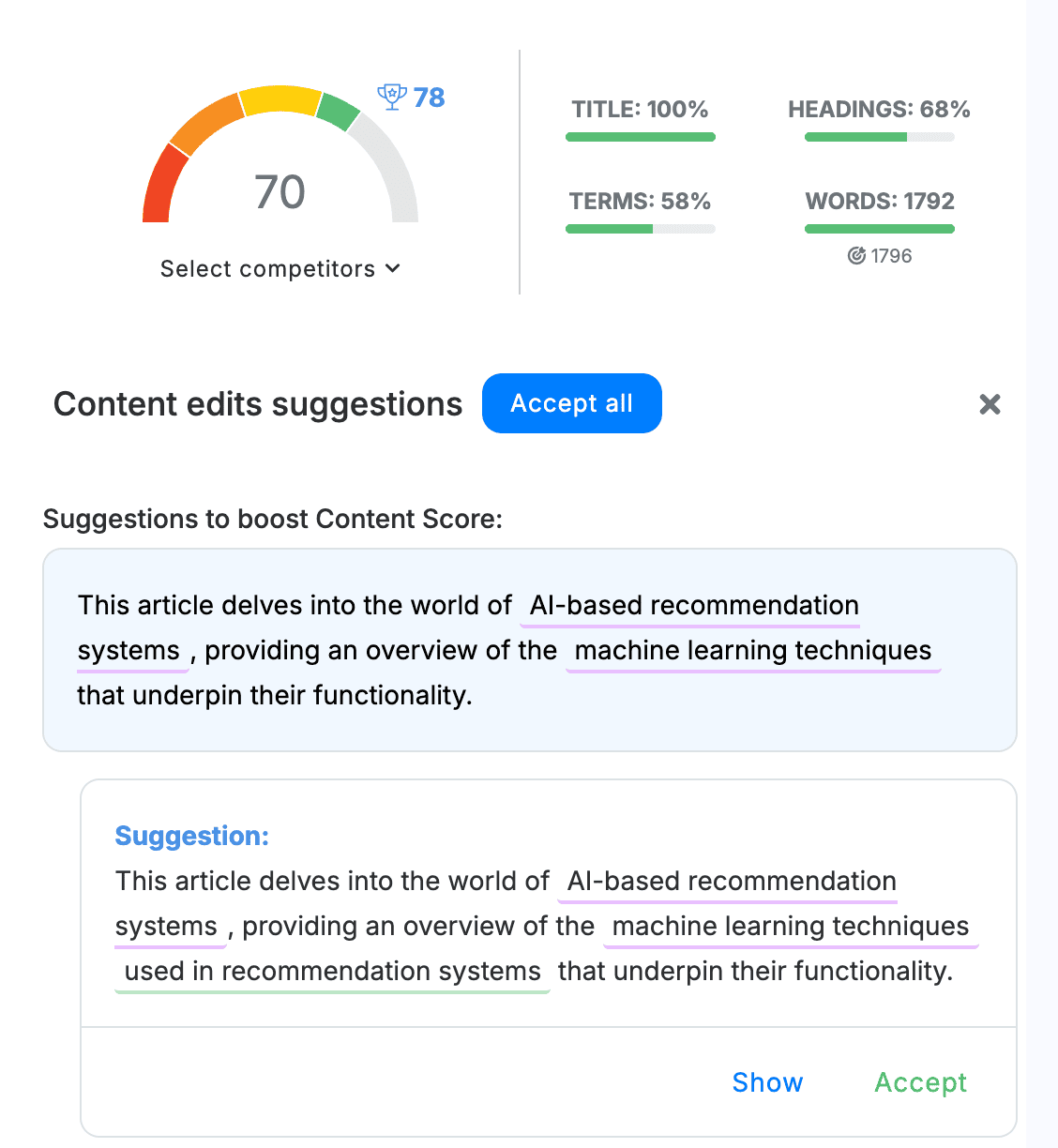
A standard NeuronWriter workflow is: 1) Enter a target keyword to start a new query. 2) Select relevant competitors from the SERP analysis. 3) Use the generated content brief and term list to write or paste in your content. 4) Optimize in the editor to achieve a high content score before publishing.
This four-step process guides a user from a blank page to a fully optimized article.
- Query & Competitor Selection: Start by entering your main keyword. NeuronWriter pulls the top results. You then select the most relevant direct competitors (e.g., other blog posts, not e-commerce pages) to create your analysis.
Source: NeuronWriter
- Brief & Outline: Open the content brief. Analyze the competitor structures, questions, and terms to create your own master outline. This is a critical step to ensure your content structure is superior.
- Drafting & Writing: Write your content directly in the editor or paste it in from another program. Focus on creating a high-quality, readable draft first.
- Optimization: This is the core loop. As you write, check the term list in the sidebar. Weave in missing "Basic" and "Extended" terms naturally. Use the AI rephrasing or expansion tools if needed. Aim to beat the highest competitor's score, but stop when the text begins to feel unnatural. Once optimized, you can publish.
NeuronWriter vs. Direct Competitors
When compared to other content optimization tools, NeuronWriter stands out for its comprehensive feature set and exceptional value. It often provides similar NLP-driven insights as more expensive competitors like Surfer SEO and Clearscope but at a more accessible price point.
NeuronWriter vs. Surfer SEO
NeuronWriter vs. Surfer SEO is a common comparison of top-tier on-page tools. While both offer strong NLP and SERP analysis, NeuronWriter is frequently praised for better value-for-money, a more inclusive feature set in base plans, and the availability of a lifetime deal.
Surfer SEO is one of the most established names in this space. It boasts a polished UI and deep data analysis. However, its pricing is significantly higher. NeuronWriter bundles its AI writer, GSC integration, and content planning into one platform, often for a fraction of Surfer's cost, making it a compelling all-in-one alternative.
NeuronWriter vs. Frase.io
Compared to Frase.io, which excels at question-based research and rapid content brief generation, NeuronWriter provides a more robust real-time editor. NeuronWriter is more focused on the deep semantic optimization stage, while Frase is stronger for initial outlining.
Frase is fantastic for understanding user intent by analyzing questions from sources like Quora, Reddit, and "People Also Ask." However, many users find that NeuronWriter's NLP term suggestions and real-time Content Score are more granular and effective for the final, intensive optimization push. While Frase helps you decide what to write, NeuronWriter excels at helping you refine how you write it for maximum SEO impact.
NeuronWriter Pricing: Is It a Good Value?
NeuronWriter's cost is structured in tiers based on the number of projects and content analyses per month, with plans often starting under $50/month. It is well-known for offering an AppSumo lifetime deal, making it a highly accessible, one-time tool investment.
With NeuronWriter, you are buying a tool. The cost is low, and the return on investment (ROI) is measured in the improved performance of the articles you manually create with it and the time you save on research. It's an investment in making your manual labor more efficient and effective. The different plans (e.g., Bronze, Silver, Gold) typically limit the number of new content analyses you can run and the quantity of AI credits you receive each month. Its availability as a lifetime deal makes it one of the most affordable and highest-value tools in the SEO market.
The Alternative: Tool-Based Optimisation vs. Full Automation
While NeuronWriter perfects the process of manually creating a single optimized article, a different class of platform aims to solve a different problem: scaling the entire content workflow. This is the philosophy of tool-based enhancement vs. end-to-end automation.
What is Natiad? The SEO Content Autopilot
Natiad is a full-scale AI SEO automation platform that manages the entire content lifecycle autonomously. It functions as an AI agent that creates a site's content roadmap, writes articles, builds internal links, and handles publishing without manual intervention.
Where NeuronWriter is a co-pilot sitting beside you in the cockpit, Natiad is the autopilot system that flies the plane for you. It's not a tool designed to help you write a better article; it's a system engineered to run your entire content marketing strategy. Natiad’s process begins by identifying strategic content pillars and topic clusters. It then generates a complete content calendar and executes that plan, handling the automated creation of dozens or even hundreds of articles, complete with a strategic internal linking web.
| Platform | Aspect | Details |
|---|---|---|
| Natiad | Core Function | An AI SEO platform that puts the entire content marketing workflow on autopilot, from planning to publishing. |
| Natiad | Content Planning | Autonomously performs keyword research and clustering to generate topical maps and a multi-month, prioritized content calendar. |
| Natiad | Content Production | Fully automates the writing, optimization, and internal linking of topically-related articles at a massive scale. |
| Natiad | Workflow | Manages the end-to-end process from initial site analysis and strategy to publishing and ongoing content ecosystem management. |
| Natiad | Goal | To drive predictable organic traffic by systematically and rapidly building comprehensive topical authority. |
Side-by-Side Comparison: NeuronWriter vs. Natiad
The difference between these two platforms is a fundamental split in the philosophy of how to win at SEO content.
Core Philosophy: Manual Enhancement vs. Full Automation
- NeuronWriter gives a master carpenter the world's most advanced set of tools. It allows for incredible precision and helps the user apply their skill to create a flawless, handcrafted piece. The focus is on perfecting the craft of a single masterpiece.
- Natiad, on the other hand, builds the entire automated furniture factory. It manages the supply chain (keywords), and runs the assembly line to produce hundreds of high-quality pieces. The focus is on perfecting the production system to dominate the market through scale, speed, and consistency.
Feature Breakdown: Tool vs. System While both platforms use AI, they apply it to solve problems at different levels. NeuronWriter focuses on the micro-level execution of a single document, whereas Natiad addresses the macro-level strategy and execution of an entire content ecosystem. This highlights a key difference between simple AI content tools and true SEO automation.
| Feature | NeuronWriter | Natiad |
|---|---|---|
| Primary Function | On-Page Content Optimization Tool | End-to-End SEO Automation Platform |
| Core Workflow | Manual: Brief -> Write -> Optimize -> Publish | Automated: Strategy -> Plan -> Create -> Link -> Publish |
| Content Planning | Generates a single-article content brief | Generates a full content calendar & topical map |
| AI Writing | Assistant: Generates sections, rephrases, expands ideas | Autonomous: Generates complete, optimized articles at scale |
| Internal Linking | Provides suggestions for manual implementation | Automated, systematic implementation across the content ecosystem |
| Ideal User | Hands-on SEO, Writer, Small Agency | Business Owner, Large Agency, Portfolio Manager |
| Investment Type | Tool: Low-cost, per-user efficiency value | System: Platform subscription, business-level ROI |
| Scalability | Limited by the user's personal time and effort | Designed for massive, automated content scaling |
Pros and Cons: Which Approach Fits Your Workflow?
NeuronWriter: The Artisan's Toolkit
NeuronWriter's pros are its granular control, affordability, and ability to empower writers with data. Its primary con is that it doesn't solve the problem of scale; the workflow remains entirely manual and time-intensive.
- Pros:
- Granular Control: You have the final say on every word, perfect for brand-centric content.
- Deep Optimization: Ideal for mission-critical pillar pages or refreshing underperforming content.
- Exceptional Affordability: The potential lifetime deal provides an accessible entry point for everyone.
- Skill Enhancement: It's a great training tool that teaches writers to think more like SEOs.
- Powerful Content Refreshing: The GSC integration makes it easy to find and re-optimize old content.
- Cons:
- Doesn't Solve for Scale: It makes one person more effective, but it doesn't multiply their output. The bottleneck is still human time.
- Entirely Manual Workflow: The entire process—writing, optimizing, publishing, internal linking—is still dependent on your manual effort.
- No Proactive Strategy: It only activates once you've already chosen a keyword. It won't help you build a strategic content calendar.
Natiad: The Content Factory
Natiad's pros are its massive scalability, end-to-end workflow automation, and strategic authority building. Its cons are less manual control over individual article nuances and a higher investment level than a single tool.
- Pros:
- Massive Scalability: It breaks the linear relationship between time input and content output.
- Full Workflow Automation: It automates the entire tedious workflow from keyword clustering to a live, internally linked post.
- Strategic Authority Building: It builds topical authority faster and more effectively through automated planning and linking.
- Resource Reallocation: It liberates human capital from tedious production to higher-value tasks.
- Consistency at Scale: Delivers a consistent quality level across hundreds of articles.
- Cons:
- Less Granular Control: You manage the system, not the individual words. It's not designed for line-by-line wordsmithing.
- Higher Initial Investment: It's a platform subscription, not a low-cost tool. The investment is in business infrastructure.
- Focus on Net-New Content: It’s primarily an engine for generating new content at scale, not for manually updating one-off historical posts.
The Verdict: Should You Optimise or Automate?
The better investment depends on your primary business bottleneck. If your content quality is the issue, NeuronWriter is a superior investment. If your content velocity and scale are the issues, an automation platform like Natiad is the better investment.
The choice between NeuronWriter and Natiad isn't about which one is "better"; it's about which one solves your biggest business problem.
Choose NeuronWriter if your bottleneck is quality. If you have the time to write, but you consistently find your content isn't ranking, NeuronWriter is an exceptional investment. It provides the data and framework to elevate your output from "good" to "hyper-competitive." It’s the perfect choice for a hands-on practitioner who wants to master their craft one meticulously optimized article at a time.
Choose Natiad if your bottleneck is time and scale. If you have a clear strategy but simply cannot produce enough high-quality content fast enough to compete, an optimization tool will only make your slow process slightly more effective. Natiad is an investment in a system that removes the human execution bottleneck entirely, allowing you to compete on velocity and topical coverage in a way that's impossible with a manual workflow.
Natiad is an AI SEO platform that puts a website's content marketing on autopilot using AI agents. It analyzes a site, creates a content roadmap, writes SEO-optimized articles, and automatically publishes them with internal links to drive traffic and revenue from search engines and AI assistants. Explore more at https://natiad.com.
Frequently Asked Questions (FAQ)
Is NeuronWriter worth the investment?
Yes, for most content creators, SEOs, and small businesses, NeuronWriter is worth the investment. Given its affordable pricing, especially the lifetime deal, it provides a massive ROI by improving content quality, saving research time, and increasing the chances of ranking.
Can you use NeuronWriter to rank #1 on Google?
Using NeuronWriter significantly increases the chance of ranking on the first page of Google by ensuring comprehensive on-page optimization. However, achieving the #1 spot also depends on off-page factors like domain authority, backlinks, and user experience.
NeuronWriter gives you a powerful competitive edge on the on-page SEO front, which is a critical piece of the puzzle. It ensures your article is "worthy" of a top spot, but it's part of a holistic blog SEO strategy that must also include technical SEO and off-page authority building.
How does the Google Search Console integration work in NeuronWriter?
NeuronWriter's Google Search Console (GSC) integration allows you to connect your website's performance data directly to the tool. It helps you identify articles with "content decay" (declining traffic) and find new keyword opportunities to prioritize for content refreshing and optimization.
How long does it take to see results with NeuronWriter?
For content refreshing, NeuronWriter can yield ranking improvements in just a few weeks. For new content, results depend on Google's indexing speed and off-page factors, but a well-optimized article will rank faster and higher than one created without data.
When you use NeuronWriter to update an existing article that's already indexed (e.g., one lingering on page two), you can see positive movement relatively quickly after Google recrawls it. For brand-new articles, you are starting from the strongest possible on-page position.
How does NeuronWriter compare to a free AI SEO writer?
A free AI writer typically only generates text without critical SERP analysis or competitor data. Tools like NeuronWriter provide the essential optimization layer, scoring your content against what's already ranking to ensure it's competitive and comprehensive.
Free AI writers are text generators. They don't know what keywords to use, how long the article should be, or what subtopics to cover for a specific query. NeuronWriter provides the recipe, meticulously crafted by analyzing the pages that have already proven successful.