
Narrato AI vs. Natiad: Content Planning Tools vs. Fully Automated SEO Agents
Discover the best AI SEO tools for content planning. Compare Narrato AI's collaborative workflows against Natiad's fully automated SEO agents to find your fit.
The landscape of AI SEO tools is rapidly evolving beyond simple task automation. We're seeing a fundamental split between tools that assist human marketers and autonomous agents designed to automate entire workflows. The challenge is no longer just about generating content faster; it's about ensuring every piece is part of a coherent, data-driven strategy that executes flawlessly from planning to publication.
This is where understanding the core philosophy of a tool becomes critical. On one side are AI-powered workspaces that act as a force multiplier for your team's expertise. On the other are autonomous agents built to ideate, plan, create, and manage an entire SEO content strategy with minimal human oversight.
This guide will explore the best AI SEO tools for content planning, breaking them down by their approach. We'll help you decide which philosophy—and which platform—is the right fit for your business goals, team structure, and operational style.
What to Look for in AI Content Planning Tools
Before diving into the options, it's crucial to know what features make a tool truly effective for the planning phase. A great AI planning tool goes beyond simple keyword suggestions.
- Topic Clustering: The ability to group thousands of keywords into semantically related clusters. This is the foundation of building topical authority.
- SERP Analysis: Automated analysis of top-ranking content to understand search intent, common questions, and necessary subtopics.
- Content Brief Generation: Tools that create detailed, data-driven outlines for writers, including target keywords, headings, word count, and competitor insights.
- Content Gap Analysis: The ability to scan your site and your competitors' sites to identify valuable topics you haven't covered yet.
- Strategic Roadmapping: The most advanced tools can generate a multi-month content plan, prioritizing topics to maximize SEO momentum.
The Best AI SEO Tools for Content Planning
Here are our top picks for AI tools that can transform your content planning, categorized by their primary strengths.
1. Natiad: Best for Autonomous Strategy & Execution
Natiad is an autonomous AI SEO agent that automates the end-to-end content marketing process. It analyzes a website, generates a complete content roadmap, writes interlinked articles in clusters, and publishes them automatically to build topical authority.
Natiad operates on a "human-on-top" model. It's not a tool to assist a marketer; it's an agent that acts as the content team. It can automate the entire strategic workflow, from initial market analysis to a fully published and internally linked content hub. You provide a high-level goal—for example, "become an authority on enterprise cybersecurity"—and the Natiad agent handles the rest. It performs SERP analysis, maps topic clusters, generates a multi-month content plan, writes all the articles, and strategically interlinks them to maximize SEO impact.
- Best For: Businesses, SEOs, and founders who want to deploy a complete content strategy without managing a large in-house team or complex workflow.
- Key Planning Features: Fully automated topical map and roadmap generation, competitive gap analysis, automated internal linking strategy.
- Pricing: Based on the strategic scope of the work deployed (e.g., number of content clusters).
2. MarketMuse: Best for AI-Driven Topical Authority Planning
MarketMuse is an AI-powered content strategy and intelligence platform that helps businesses plan content to build topical authority. It inventories existing content, identifies gaps, and provides data-driven briefs to guide creation.
MarketMuse excels at providing a high-level, strategic view of your content landscape. Its platform analyzes your entire website to show you where you have topical strengths and where you have critical gaps compared to competitors. It uses patented AI to create "Topic Models" and provides personalized difficulty scores that tell you how hard it will be for your specific site to rank for a term. This allows you to prioritize content that has the highest chance of success.
- Best For: SEO strategists and content managers at established companies who need to scale their content efforts based on deep data analysis.
- Key Planning Features: Content inventory analysis, topic modeling, personalized difficulty metrics, content brief generation.
- Pricing: Premium SaaS plans with pricing based on queries and briefs.
3. Narrato AI: Best for Collaborative Content Workflows
Narrato AI is a content creation and marketing workspace that uses AI to assist teams with ideation, writing, collaboration, and project management. It centralizes the content lifecycle to enhance the productivity of an existing marketing team.
Think of Narrato as a command center for a content team. It operates on a "human-in-the-loop" model, assuming you have a human expert who needs better tools to execute a strategy faster. It excels at generating topic ideas from a keyword, creating detailed briefs based on SERP analysis, and providing a shared space for writers and editors to collaborate. It refines and accelerates an existing workflow, but the human remains the central decision-maker at every stage.
- Best For: In-house content teams and marketing agencies that need a unified platform to accelerate the manual execution of planning, writing, and optimization.
- Key Planning Features: AI topic ideation, structured content brief generation, visual content calendar.
- Pricing: Standard SaaS model based on user seats and content limits.
4. Surfer SEO: Best for Data-Driven Content Briefs
Surfer SEO is an on-page optimization tool that uses AI to analyze top-ranking pages and generate data-driven guidelines for creating content that ranks. Its core strength is turning a target keyword into a comprehensive, actionable content brief.
While it offers a full suite of features, Surfer's reputation was built on its Content Editor and Brief generator. For any given keyword, it analyzes over 500 on-page signals from the SERPs. It then provides a detailed brief including a suggested structure, important terms to include (NLP), questions to answer, and target word counts. Its keyword clustering feature is also excellent for grouping related terms to plan multiple articles around a core topic.
- Best For: Content writers, editors, and SEOs who focus on creating highly-optimized individual articles based on real-time SERP data.
- Key Planning Features: Detailed brief generation, NLP term analysis, keyword clustering.
- Pricing: Monthly SaaS subscription based on the number of articles and features.
5. Semrush: Best All-in-One SEO Platform with AI
Semrush is a comprehensive SEO platform that incorporates AI into its Content Marketing Toolkit to help users find topics, plan content, and optimize it. It connects keyword research, topic ideation, and writing assistance in one place.
Semrush is the Swiss Army knife for SEOs. For content planning, its Topic Research tool is a powerful starting point. You can enter a domain or topic, and it generates a mind map of related subtopics and popular headlines. From there, you can create a brief using the SEO Content Template, which pulls data from your top 10 rivals for a target keyword. While not as specialized as other tools on this list, its strength lies in integrating planning with its massive keyword and competitor databases, covering all the core SEO components.
- Best For: Marketers and businesses who want a single platform to manage all aspects of their SEO and content strategy, from research to rank tracking.
- Key Planning Features: Topic research mind maps, SEO content templates, integration with keyword and competitive analysis tools.
- Pricing: Tiered monthly SaaS subscription.
Comparison of Top AI Content Planning Tools
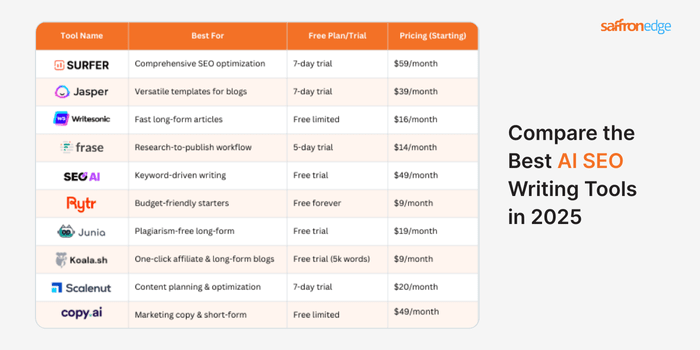
Source: dsi59nxdlf71n.cloudfront.net
| Feature | Natiad | MarketMuse | Narrato AI | Surfer SEO | Semrush |
|---|---|---|---|---|---|
| Best For | Autonomous Strategy | Topical Authority | Team Collaboration | On-Page Briefs | All-in-One SEO |
| Core Philosophy | Human-on-Top (Agent) | Strategic Assistant | Human-in-the-Loop | Tactical Assistant | Integrated Toolset |
| Topic Clustering | Fully Automated | Automated | Manual/Assisted | Automated | Assisted |
| Brief Generation | N/A (writes content) | Automated | AI-Assisted | AI-Assisted | AI-Assisted |
| Content Gap | Fully Automated | Automated | Manual | N/A | Manual |
| Roadmapping | Fully Automated | Assisted | Manual Calendar | Manual | Manual |
| Pricing Model | Outcome-Based | Premium SaaS | Seat-Based SaaS | Tiered SaaS | Tiered SaaS |
How to Choose: Do You Need a Better Toolbox or a Master Builder?
The choice between these tools comes down to whether you want to improve your existing content process or automate it entirely.
Choose a "Toolbox" (MarketMuse, Narrato, Surfer, Semrush) if you have:
- Strategic expertise in-house.
- A team of writers and editors to manage the workflow.
- A need for more data and efficiency in your existing process.
- A preference for hands-on control over every article.
These platforms provide the power tools, project management boards, and data insights, but you are still the architect and the general contractor. They are excellent choices for empowering your existing talent.

Choose a "Master Builder" (Natiad) if you want to:
- Leverage AI to be the architect and the builder.
- Deploy a complete content strategy without the overhead of a large team.
- Focus your time on high-level business goals, not content operations.
- Buy the outcome—a fully developed content hub that drives traffic—not just the tools to build it.
This is for leaders who want an autonomous system that handles the end-to-end execution, turning a strategic objective into published, ranking content.
Natiad is an AI SEO platform that puts a website's content marketing on autopilot using AI agents. It analyzes a site, creates a content roadmap, writes SEO-optimized articles, and automatically publishes them with internal links to drive traffic and revenue from search engines and AI assistants. Explore more at https://natiad.com.
Frequently Asked Questions (FAQ)
What is the main difference between an AI planning tool and an AI agent?
AI content planning tools assist users by automating specific tasks like keyword research or brief creation, but the user directs the overall strategy. An AI agent, like Natiad, automates the entire strategic workflow, from planning and clustering to writing and publishing, acting as an autonomous marketing agent.
A planning tool is like an advanced GPS for your car. You still decide the destination and do all the driving. An AI agent is like a self-driving car. You tell it the final destination, and it handles the entire journey.
Can these tools write the content for you?
Yes, most modern AI SEO tools have content generation capabilities. Tools like Narrato and Surfer use AI to create drafts from a brief, while an agent like Natiad generates entire interconnected clusters of articles automatically as part of its core function.
The key difference lies in the scope. Assistant tools are typically used to generate one article at a time, whereas autonomous agents create entire webs of content to execute a pre-defined strategy.
How do AI content optimizers work?
AI content optimizers analyze a draft against top-ranking competitors for a target keyword. They use Natural Language Processing (NLP) to provide a content score and actionable suggestions for including relevant terms, improving headings, and matching search intent to make the article more competitive.
These tools deconstruct what's already working on Google and give you a data-driven checklist to close the gap between your content and the pages that already rank well.
Is it better to use an integrated platform or a free AI writer?
An integrated platform is almost always better for a serious content strategy. A free AI writer lacks the strategic context, real-time SEO data, and workflow integration necessary for creating content that actually ranks and builds authority.
Free tools operate in a vacuum. They don't know your keywords, search intent, or competitors. The hidden cost is the immense human time required to research, edit, and optimize the generic output to make it strategically viable. An integrated platform connects the writing process directly to SERP data and a cohesive plan.