
The Leading AI Platforms for SEO & Marketing Automation in 2026
Discover the leading AI platforms for SEO & marketing automation in 2026. We compare top AI writers and engines that automate your entire content workflow.
The market for AI in marketing has evolved from simple AI writers to comprehensive SEO automation platforms. In 2026, the discussion around automated content creation has completely changed; a basic AI blog writer is no longer the key to a competitive edge. Marketers face a "content velocity" crisis—the need to publish high-quality, authoritative content at a pace that outmaneuvers competitors. Early AI writers solved the speed problem but often created a new strategic bottleneck, leaving teams with a pile of disconnected articles and no clear path to ranking.
The leading tools are now integrated platforms that fuse AI-driven writing with essential SEO functions like keyword clustering, on-page optimization, and automated internal linking. These advanced systems don't just generate ai articles; they are engineered to manage the entire content marketing workflow, from initial strategy to final publication. This is a critical evolution for any marketing team serious about scaling their search presence. AI is reshaping professional workflows, and SEO is on the front lines. This analysis will break down the top players, helping you distinguish between a simple seo ai writer tool and a true marketing automation engine designed for growth.
What's the Difference Between an AI SEO Writer and an Automation Platform?
An AI SEO writer is a tool that generates text, while an SEO automation platform is an end-to-end system that executes a content strategy. Think of it this way: an ai seo writing assistant is like a powerful power drill—it helps a skilled human work faster and more efficiently on a specific task. An automation platform, on the other hand, is the entire automated assembly line. It handles the process from raw materials (keyword research and SERP analysis) to finished product (a published, internally-linked article) with minimal human intervention.
While a writer requires constant prompts, direction, and manual integration into a larger workflow, a platform can independently analyze a domain, identify opportunities, create a content calendar, write articles in bulk, and analyze performance over time. The fundamental difference lies in who is directing the strategy: with a writer, the human is the strategist; with a platform, the AI becomes a strategic partner.
Comparison: Core Capabilities
A standard AI writer focuses on one-off text generation, whereas an SEO automation platform manages the entire content lifecycle. This table breaks down the fundamental differences in what these two classes of tools actually do for your business. The distinction isn't just about features; it's about the scope of the problem they solve—a single article versus an entire growth strategy.
| Feature | Standard AI Writer (e.g., Rytr, Copy.ai) | SEO Automation Platform (e.g., Natiad) |
| Primary Function | On-Demand Text Generation | End-to-End Workflow Automation |
| Keyword Research | Requires Manual Input from User | Automated Clustering & Opportunity Analysis |
| Content Strategy | Defined entirely by the User | AI-Generated Content Roadmap & Silos |
| Article Creation | One-off ai seo article writer | Programmatic Bulk Content Creation |
| On-Page SEO | Basic Keyword Insertion, Manual Optimization | Real-time SERP Analysis & Automated Optimization |
| Internal Linking | Manual Task for the User After Writing | Automated Contextual Link Building During Creation |
| Publishing | Manual Copy & Paste to CMS | Direct CMS Integration & Automated Scheduling |
| Goal | Make a writer more efficient | Make a content strategy autonomous |
Methodology: How We Ranked the Leading Tools
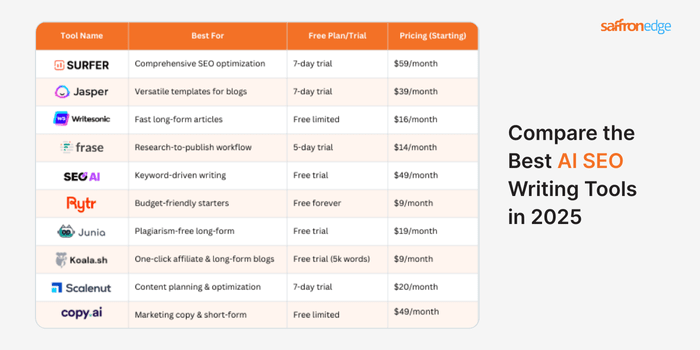
To provide a clear and practical comparison, we evaluated each platform against a set of core criteria that reflect the needs of modern SEO and marketing teams. Our ranking methodology prioritizes strategic impact and workflow efficiency over raw text generation capabilities alone.
Source: Natiad
- Strategic Automation: We assessed the tool's ability to automate tasks beyond writing, such as keyword clustering, content planning, and internal linking. The highest scores went to platforms that could manage more of the end-to-end SEO content lifecycle.
- SEO Feature Depth: We analyzed the robustness of SEO-specific features. This included the quality of SERP analysis, the sophistication of on-page optimization recommendations (e.g., NLP terms, content structure), and the intelligence of its keyword integration.
- Output Quality & Control: We evaluated the coherence, accuracy, and "human-likeness" of the generated content. We also considered the level of user control over tone, style, factual data, and overall article structure.
- Workflow Integration: We considered how easily the tool integrates into a professional marketing technology stack. This includes direct CMS integrations (like WordPress), collaboration features, and compatibility with other essential SEO tools.
- User Experience (UX): We measured how intuitive and efficient the platform is for its intended user. A tool designed for a solo blogger has different UX requirements than a platform built for a large marketing team managing content at scale.
The Best AI SEO Platforms for Full-Cycle Marketing Automation
The best AI SEO platforms are evaluated on their ability to support a comprehensive and automated strategy, not just writing quality. Here, we review the leading platforms and tools. The key distinction we're making is how much of the manual, time-consuming SEO work each tool can take off your plate. Some are excellent assistants, while others are true autonomous agents for your content marketing.
1. Natiad: The End-to-End SEO Automation Engine
Best for: Teams seeking to put their entire content strategy on autopilot and scale topical authority.
Natiad is a strategic AI SEO platform designed to function as a complete operating system for search-driven growth. It moves beyond simple content generation to act as an AI-powered agent for your marketing team. In practice, this means you provide a domain and high-level topic goals, and Natiad autonomously performs a site audit, identifies content gaps, maps out entire topic clusters, generates dozens of interlinked articles to cover those clusters, and then schedules them for direct publication to your CMS.
This approach is fundamentally different from a tool that just writes ai articles. It's designed for businesses that understand SEO success comes from building topical authority systematically, not just publishing random blog posts. It automates the high-level strategic work—the "what to write about," "how to structure it," and "how to connect it all"—that typically consumes countless hours of expert time.
| Tool | Detail | Takeaway |
| Natiad | Content Lifecycle | Automates the entire process: strategy, writing, optimizing, publishing, and linking. |
| Natiad | Strategic Focus | Builds topical authority through programmatic, data-driven content clusters. |
| Natiad | Core Technology | Functions as an autonomous AI agent, not just a responsive writing tool. |
| Natiad | Internal Linking | Automatically builds a powerful site architecture with contextual internal links. |
- Pros:
- Enables truly hands-off
automated content creationat scale. - Builds a cohesive, long-term content strategy based on data, not guesswork.
- Dramatically reduces manual SEO workload, freeing up teams for revenue-focused tasks.
- Focuses on traffic and business outcomes by design, not just word count.
- Cons:
- Represents a higher strategic investment than single-purpose writer tools.
- Best suited for users with a foundational understanding of SEO principles who want to scale.
2. Writesonic: The Versatile AI Writer with Growing SEO Ambitions
Best for: Marketers and agencies needing a high-quality, versatile AI assistant for a wide range of content formats.
Writesonic is a popular and versatile AI writer that produces high-quality marketing copy across many formats, from Google Ads to long-form blog posts. It has become a go-to for many marketers due to its user-friendly interface and consistently strong output.
The platform's "Sonic Editor" provides a great hybrid experience, blending AI assistance within a familiar document editor. This makes co-creating content with the AI feel seamless—you can highlight a paragraph and ask the AI to expand upon it, rephrase it for a different audience, or shorten it, all within the same window.
While Writesonic is excellent for general copywriting and has been adding more SEO-focused features, it primarily functions as a powerful assistant. It helps you write and optimize an article you've already decided to create, but it doesn't automate the preceding strategic steps of keyword clustering or content calendar generation.
| Tool | Detail | Takeaway |
| Writesonic | Primary Use Case | Excels at generating a wide variety of marketing copy, including ai articles. |
| Writesonic | Key Feature | The "Sonic Editor" offers a powerful and intuitive co-creation experience. |
| Writesonic | SEO Capabilities | Includes features to optimize content for keywords during the writing process. |
| Writesonic | Strategic Automation | Functions more as an ai seo writing assistant than a full automation platform. |
- Pros:
- Generates high-quality, readable output across numerous content templates.
- The user-friendly interface is accessible for beginners and experienced marketers alike.
- Offers a generous free trial for users to test its extensive capabilities.
- Cons:
- Its SEO features are designed to assist a human writer, not automate the strategy.
- Lacks deep strategic components like automated keyword clustering or content roadmapping.
3. Surfer SEO: The On-Page Optimization Powerhouse
Best for: SEOs and content editors focused on perfecting the on-page optimization of individual articles to maximize ranking potential.
Surfer SEO is a data-driven tool focused on creating content that is perfectly optimized to rank for a specific target keyword. It's less of a pure writer and more of an optimization and analysis suite. Its core function is to analyze the top-ranking pages for a query and provide a detailed, actionable brief.
The Content Editor gives real-time feedback on everything from keyword density and NLP terms to content structure and word count. The experience is almost like a video game for SEOs; as you write, a sidebar provides a checklist of terms and structural elements, and your content score from 0-100 increases as you turn suggestions from red to green.
Source: The Algorithmic Bridge
Surfer's ai seo writing functionality is designed to help you execute on its data-driven recommendations. It can generate outlines and draft paragraphs based on its SERP analysis, but its main value is in guiding the optimization process. It's the best tool on the market for ensuring a single piece of content is maximally competitive.
| Tool | Detail | Takeaway |
| Surfer SEO | Core Function | Data-backed, real-time on-page optimization based on SERP analysis. |
| Surfer SEO | "Grow Flow" | Provides weekly, actionable tasks to improve existing site SEO. |
| Surfer SEO | AI Integration | AI capabilities are used to generate outlines and drafts based on competitor data. |
| Surfer SEO | Workflow Stage | Excels at the content optimization and editing stage, not initial strategy. |
It integrates smoothly with other tools like Jasper and Google Docs, making it a valuable addition to an existing content workflow. However, it doesn't automate the initial phases of deciding what content to create.
- Pros:
- Provides unparalleled data for on-page SEO optimization.
- Excellent for upgrading existing content to improve its rankings.
- Helps writers create highly competitive articles from the start.
- Cons:
- Writing is a feature, not the core product; it's not a high-volume generator.
- Does not automate the keyword research or content strategy phases.
4. Frase: The Content Research and Briefing Specialist
Best for: Content teams and agencies that want to streamline the research and briefing process to ensure comprehensive, expert-level articles.
Frase is an AI-powered tool that excels at the research and briefing stage of content creation. It automates one of the most time-consuming parts of writing SEO content: figuring out what to include. After you input a target keyword, Frase analyzes the top search results and automatically generates a comprehensive brief, complete with competitor heading structures, "People Also Ask" questions, relevant external sources, and key statistics. This condenses hours of manual SERP analysis into a few minutes.
This makes it an incredibly powerful ai seo writing assistant for human writers. By providing a detailed, data-backed blueprint, Frase empowers writers to create expert-level content that thoroughly covers user intent. Its content optimization editor then scores the draft against competitors, similar to Surfer.
| Tool | Detail | Takeaway |
| Frase | Main Strength | Automates content research and the creation of detailed SEO briefs. |
| Frase | Content Optimization | Features an editor that scores content against top-ranking competitors. |
| Frase | User Focus | Empowers human writers by drastically reducing research and planning time. |
| Frase | Native AI Writer | Its own AI writing feature is functional but less advanced than dedicated writers. |
- Pros:
- Saves countless hours of manual content research and SERP analysis.
- Helps ensure every article is comprehensive and answers key user questions.
- Excellent for building a process around creating high-quality, expert content.
- Cons:
- Its built-in AI writer is not as powerful as tools like Writesonic or Jasper.
- It is an assistant and optimizer, not a full-cycle automation platform.
5. Copy.ai: The Go-To-Market and Sales Copywriting Tool
Best for: Sales and marketing teams that need to generate high volumes of on-brand, conversion-focused copy for campaigns.
Copy.ai is an AI writing tool tailored for go-to-market (GTM) and sales teams needing high volumes of conversion-focused copy. While many tools on this list focus on long-form SEO content, Copy.ai shines in producing short-form, persuasive copy for emails, social media, product descriptions, and ads.
For example, a user could input a product's features and benefits, and the tool could generate a complete cold outreach email sequence, a series of LinkedIn posts, and corresponding ad copy, all while adhering to a pre-defined brand voice.
A key strength is its focus on maintaining that consistent brand voice, which is critical for GTM communications. However, it's not designed to be a primary ai seo blog writer. Its feature set lacks the deep SEO analysis, SERP data integration, and long-form content structures required to power a serious content strategy for search engines.
| Tool | Detail | Takeaway |
| Copy.ai | Target Audience | Primarily serves go-to-market, sales, and marketing teams. |
| Copy.ai | Content Focus | Excels at short-form, conversion-focused copy (emails, ads, social). |
| Copy.ai | Key Feature | Strong emphasis on generating content that adheres to a specific brand voice. |
| Copy.ai | SEO Capability | Lacks the deep SEO analysis features needed for a strategic content plan. |
- Pros:
- Perfect for teams that need to produce on-brand sales and marketing copy quickly.
- Features an intuitive, chat-based interface that is easy to use.
- Offers workflow tools that streamline common GTM tasks.
- Cons:
- Not built for long-form SEO content or topic authority building.
- Is not a substitute for a dedicated
seo ai writer tool.
6. Rytr: The Budget-Friendly AI Writing Assistant
Best for: Solopreneurs, students, and beginners looking for an affordable tool to overcome writer's block and generate short-form content ideas.
Rytr is a highly accessible and affordable AI writing tool, making it ideal for individuals or small teams just starting with AI-powered content. It provides a simple interface and dozens of templates (or "use cases") for different types of short-form content, from email subject lines to YouTube video descriptions. Its "Magic Command" feature is useful for brainstorming, allowing you to give it freeform instructions like "write three potential blog titles about cold brew coffee."
While Rytr can generate sections of blog posts, its output for long-form ai articles can be inconsistent and often requires significant human editing and assembly. It's a fantastic tool for overcoming writer's block or quickly drafting short pieces of copy. However, it has virtually no strategic SEO features and should be viewed as a basic writing aid rather than a tool for building a search presence.
| Tool | Detail | Takeaway |
| Rytr | Price Point | One of the most affordable and accessible AI writers on the market. |
| Rytr | Best Use Case | Quickly generating short-form content and brainstorming ideas. |
| Rytr | Interface | Extremely simple and easy to use, with a minimal learning curve. |
| Rytr | SEO Features | Has minimal to no strategic SEO capabilities for content planning or optimization. |
- Pros:
- Extremely affordable, with a generous free plan that's great for experimentation.
- Very fast and simple for generating short-form copy and ideas.
- Cons:
- Long-form content quality is often inconsistent and requires heavy editing.
- Lacks any meaningful features for SEO strategy, planning, or optimization.
How to Choose the Right AI SEO Writing Tool for Your Goals
Selecting the right AI SEO tool requires assessing your workflow and desired level of automation, not just comparing features. The market is crowded, and the "best" tool is entirely dependent on your specific objectives. A freelancer needing help with a single blog post has very different needs than a business trying to dominate a niche with hundreds of articles.
Step 1: Define Your Goal—Writer's Assistant or Automation Engine?
First, you must decide if you need a tool to assist human writers or a platform to run entire content operations. This is the most important distinction. An ai seo writing assistant is designed to augment your existing team, making them faster and more data-informed.
An automation engine is designed to replace entire manual workflows, executing a strategy autonomously. Be honest about your capacity and goals. Are you looking to improve your current process or build a new, scalable one?
Step 2: Evaluate SEO-Specific Capabilities
A true seo ai writer tool must offer capabilities far beyond simple text generation. If your goal is to rank on search engines, look for platforms that integrate the full spectrum of SEO tasks. Generic AI writers that just string sentences together won't cut it.
Here is a checklist of critical components to evaluate:
- Data-Driven Keyword Analysis: Does the tool simply accept a keyword, or does it perform deeper analysis? Look for automated keyword clustering, which groups related terms into content silos, and real-time SERP analysis that identifies what's already ranking.
- Strategic Planning: Does the platform help you build a content roadmap or topical map? The ability to plan content in logical clusters is essential for building authority and is a hallmark of advanced
ai seo writing tools. - On-Page Optimization: Look for real-time content scoring, NLP (Natural Language Processing) term suggestions, and content structure recommendations based on an analysis of top competitors.
- Internal Linking: This is a huge differentiator. Manually building internal links is slow and prone to error. A platform that suggests or automates this process can build a much stronger site architecture. Does it just suggest links, or can it insert them contextually into the generated text?
[How the #1 Ranked SEO Article Writers Automate Internal Linking](/blog/how-the-1-ranked-seo-article-writers-automate-internal-linking) - CMS Integration: Check for direct integration with your content management system (e.g., WordPress, Webflow). This removes the tedious copy-paste step and enables true publishing automation.
Step 3: Master Best Practices for Quality AI Output
The quality of AI-generated content is a direct reflection of the quality of your process and prompts, regardless of the tool. No platform is a magic button. To get output that truly performs, you need to master the human side of the collaboration.
- Refine Your Prompting with a Framework: This is the most critical skill. Don't just give the AI a keyword. Use a structured prompting method for better results. For example:
- Role: "Act as an expert SEO content writer specializing in B2B SaaS."
- Objective: "Write a 1500-word blog post that explains the benefits of cloud-based project management."
- Persona: "The target audience is a non-technical project manager at a mid-sized company who is frustrated with their current on-premise software."
- Format: "Structure the article with an introduction, five main benefit sections with H2 headings, a short case study example, and a concluding summary. Use bullet points to list features."
- Constraints: "Maintain a professional but approachable tone. Do not use overly technical jargon. Ensure the conclusion summarizes the key takeaways."
- Follow a Human-in-the-Loop Workflow: Always plan for a human editing step. This is where you add value that an AI cannot.
- Fact-Check: Verify all statistics, claims, and product names. This is non-negotiable, as LLMs can "hallucinate" incorrect data.
- Inject E-E-A-T: Add Experience, Expertise, Authoritativeness, and Trustworthiness. This means inserting unique insights, personal anecdotes, quotes from industry experts, or proprietary data.
- Refine Brand Voice: Polish the language to perfectly match your brand's specific tone and style guide.
- Add Visuals: Insert relevant images, infographics, or videos to improve engagement and break up the text.
Tutorial: A Step-by-Step Workflow for Creating an SEO-Optimized Article with an AI Writer
This workflow combines the best of AI efficiency with essential human oversight, using a typical AI writing assistant.
- Phase 1: Strategic Foundation (Human-Led)
- Keyword Research: Use a tool like Ahrefs or Semrush to identify a primary keyword with appropriate difficulty and search volume.
- SERP Analysis: Manually review the top 5-10 ranking pages. Identify common themes, user intent (Is it informational? Commercial?), and content formats (listicles, how-to guides, etc.). This human insight is crucial.
- Create the Brief: Based on your analysis, create a detailed content brief. This should include the target keyword, secondary keywords, target audience, desired word count, and a proposed H2/H3 outline.
- Phase 2: AI Generation (The First Draft)
- Prompt Engineering: Feed your detailed brief into your chosen
AI SEO writer. Start by asking it to generate just the outline to see if it's on the right track. - Section-by-Section Generation: Generate the content for each section of your outline individually. This gives you more control and makes it easier to course-correct if the AI goes off-topic. Ask it to write the introduction, then each H2 section, and finally the conclusion.
- Phase 3: SEO Optimization (Human-Guided)
- On-Page Polish: Copy the generated draft into an optimization tool like Surfer SEO or the platform's built-in editor.
- Address Recommendations: Systematically work through the tool's suggestions. Incorporate missing NLP terms, adjust heading structures, and refine keyword density until you reach a high content score.
- Phase 4: E-E-A-T and Fact-Checking (Human-Critical)
- Verify Everything: Go through the article line-by-line and fact-check every statistic, date, and claim.
- Add Unique Value: Weave in your own expert opinions, a personal story, a quote from a colleague, or a link to your own case study. This is what separates your content from generic AI output.
- Phase 5: Final Polish and Publishing (Human-Finalized)
- Readability Edit: Read the entire article aloud to catch awkward phrasing and improve flow. Use a tool like Hemingway Editor to simplify complex sentences.
- Add Links and Media: Manually add high-quality internal and external links. Embed relevant images, charts, or videos.
- Format and Publish: Ensure the article is properly formatted in your CMS with clear headings, short paragraphs, and bolded text for scannability before hitting publish.
Natiad is an AI SEO platform that puts a website's content marketing on autopilot using AI agents. It analyzes a site, creates a content roadmap, writes SEO-optimized articles, and automatically publishes them with internal links to drive traffic and revenue from search engines and AI assistants. Explore more at https://natiad.com.
Frequently Asked Questions About AI Writers for SEO Marketing
This section answers common questions about using AI writers for SEO, covering topics from the best tools to the detectability of AI content.
What is the best AI SEO writer?
The best AI SEO writer is a platform that integrates content generation with a complete automation strategy. While standalone writers like Writesonic are excellent for creating individual high-quality articles, the "best" solution for achieving significant SEO results is a platform like Natiad that manages the entire process. This includes keyword research, content planning, on-page optimization, and internal linking. A tool's value is determined by its ability to build topical authority at scale, not just its ability to write a single article.
Can I find an ai seo writer free?
Yes, many tools provide an ai seo writer free version or a trial, which are useful for testing basic text generation. However, these ai seo writing free plans come with significant limitations. They typically impose strict word count limits (often enough for only a few articles) and lock the most valuable features—like SERP analysis, advanced optimization, and bulk generation—behind a paywall. They are excellent for experimentation but are not a viable solution for executing a serious, ongoing content strategy.
How does an AI blog writer work?
An AI blog writer functions by using a large language model (LLM) that has been trained on vast amounts of text and data from the internet. Think of it like the world's most sophisticated autocomplete. When you give the ai seo blog writer a prompt, it doesn't "understand" the topic in a human sense. Instead, it uses complex algorithms to predict the most statistically likely sequence of words to form sentences and paragraphs that match the patterns it learned during its training. The more specific your prompt, the better it can narrow down the statistical probabilities to generate a relevant and coherent response.
Is AI-generated content undetectable?
While some services claim to offer an undetectable ai seo writer, the focus should be on quality, not stealth. Google's official guidance is to reward high-quality, helpful, and user-first content, regardless of how it was created. The real risk is not "AI detection," but producing low-value, unoriginal, or factually incorrect content that fails to satisfy user intent.
Google's core updates are increasingly focused on identifying content that lacks E-E-A-T (Experience, Expertise, Authoritativeness, and Trust). Therefore, the goal isn't to trick detectors but to use AI as a tool to produce superior, factually accurate, and engaging content that is strategically guided and refined by human experts. The concept of a journalist ai seo writer highlights this need for accuracy and quality above all else.
The Future is Automated: Moving Beyond Words to Workflows
The most leading AI writers for SEO marketing in 2024 are the platforms that understand the bigger picture. Generating text is quickly becoming a commodity. The real, defensible value now lies in automating the complex, time-consuming strategic work that surrounds the writing process.
This includes the painstaking research, the clustering of keywords into a coherent strategy, the optimization against top competitors, and the meticulous construction of a site's internal linking architecture. These are the tasks that truly move the needle for traffic and revenue but are often neglected due to their high manual cost.
As you evaluate your options, the critical question to ask is not just "How well does it write?" but "How much of my entire SEO workflow can it automate?" This shift in perspective is the key to unlocking true scale and building a lasting competitive advantage. The future of content marketing isn't just about writing faster; it's about building smarter, more efficient growth engines. The most forward-thinking teams are now adopting platforms that provide AI agents to run their content marketing on autopilot, allowing them to focus on high-level strategy and business growth.