
Beyond 1-Click Articles: How to Automate Your Entire SEO Strategy with AI
Stop creating random 1-click SEO articles. Learn to automate your entire SEO strategy with AI, from keyword mapping to content publishing for scalable growth.
The promise of 1-click SEO articles is seductive: instant, optimized content designed to rank. This technology represents a significant leap in content marketing, offering unprecedented speed and efficiency. However, a single click that generates an article is not a strategy. It's like having a high-performance engine without a car, a chassis, or a steering wheel.
True growth comes from automating the entire system—the research, planning, linking, and publishing—that makes each click a strategic execution, not just a random act of content creation. This guide outlines the five steps to move beyond simple article generation and put your entire SEO content engine on autopilot. We'll explore the tools that make this possible, how to build a strategy they can execute, and the human-in-the-loop workflows that ensure quality and drive real business results.
A Note on "1-Click SEO": The term can be confusing. Some search results for this keyword refer to browser extensions like "SEO META in 1 CLICK," which are excellent tools for analyzing the on-page SEO of an existing page. This article focuses on the other meaning: tools that generate complete SEO-optimized articles with a single click. We'll cover both how to use generation tools strategically and how analysis tools fit into the final review process.
Prerequisites: A foundational understanding of your business goals, target audience, and core value proposition. You should know what you sell, who you sell it to, and why they should choose you. Tools Needed: An AI SEO platform (not just a writer), a keyword research tool (often integrated), and an analytics platform (e.g., Google Search Console). Outcome: A scalable, repeatable system for generating strategically-aligned, high-performing SEO content with minimal manual intervention, freeing up your team for high-level strategy and creative differentiation.
Step 1: Understand the Promise and Peril of 1-Click Generation
The promise of 1-click generation is rapid content scaling and cost efficiency, but its peril lies in creating generic, unstrategic articles that lack brand voice, factual accuracy, and the internal links necessary to build topical authority.
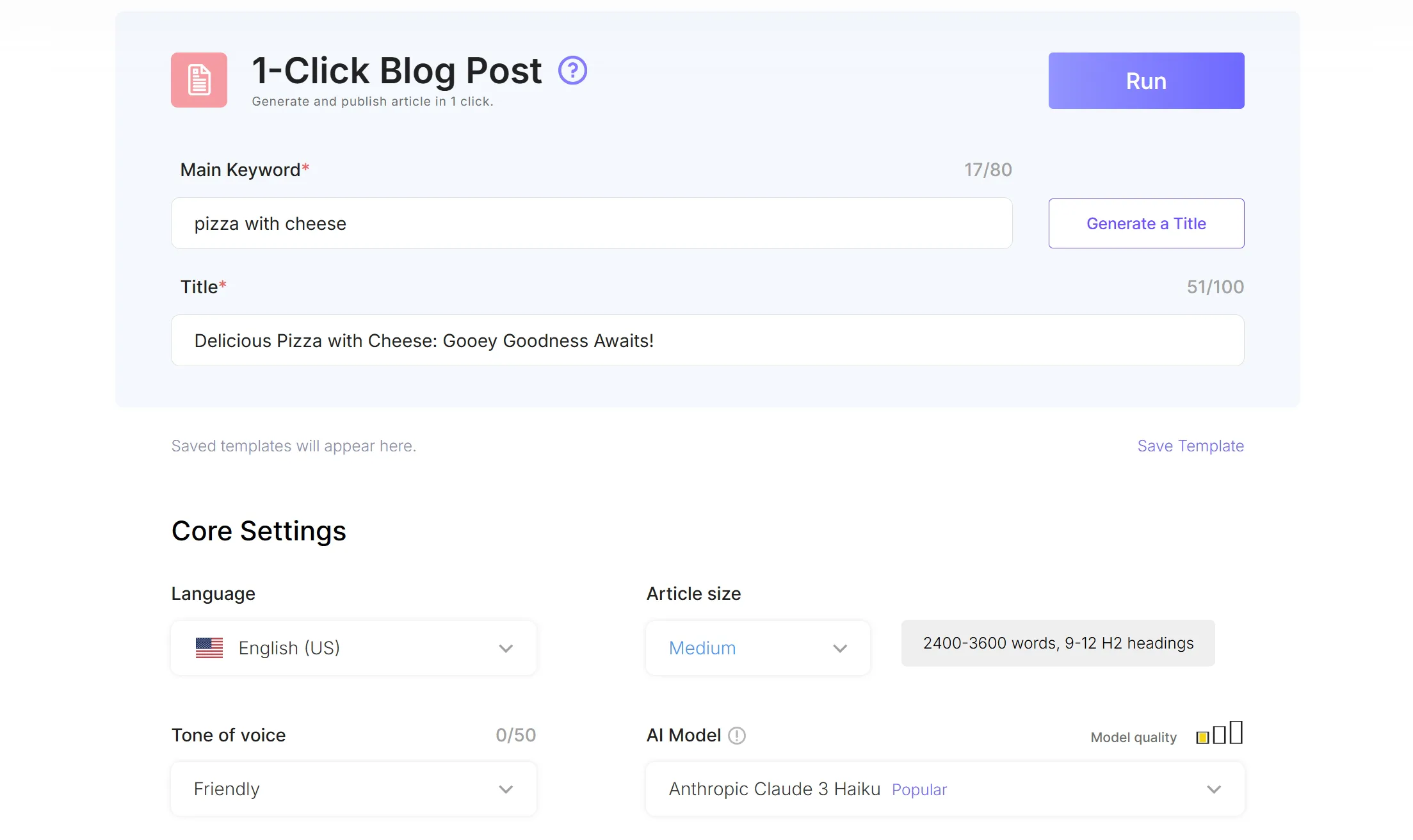
The allure of an AI blog writer or AI SEO article writer is undeniable. With a single prompt, you can produce a full-length article in minutes, drastically accelerating publishing velocity. For teams under pressure to produce more content with fewer resources, these tools seem like the perfect solution.
However, relying solely on a simplistic "1-click" approach is a strategic dead end. The output is often a collage of scraped information, lacking a unique perspective or deep alignment with your brand's expertise. This leads to several critical pitfalls:
- Content Saturation: When everyone uses the same basic tools with simple prompts, the search results become flooded with generic, repetitive content. Your article will look and sound like everyone else's, making it impossible to stand out.
- Factual Inaccuracy (Hallucinations): Basic AI models can confidently state incorrect facts or invent sources. A 1-click article without a rigorous human review process is a liability that can damage your brand's credibility.
- Lack of E-E-A-T: Google’s quality guidelines emphasize Experience, Expertise, Authoritativeness, and Trustworthiness. A generic article generated in a vacuum demonstrates none of these qualities. It lacks personal experience, unique insights, and the web of internal and external signals that build trust.
- Strategic Isolation: These articles often exist in a vacuum. They are not connected to a broader content plan or fortified with the internal links that signal topical authority to search engines. According to Google's own SEO starter guide, isolated, "orphan" articles are far less likely to be discovered and ranked.
 Source: behance.net
The initial draft from a basic AI SEO writer is merely raw material. A high-performance SEO strategy requires content that is not only optimized for keywords but also interconnected, authoritative, and aligned with a larger plan.
Step 2: Lay the Strategic Foundation for Automated Content
The strategic foundation for automated content involves three phases: comprehensive keyword and topical mapping for precise targeting, defining brand voice and governance rules for consistency, and creating scalable content briefs and templates to guide the AI.
Automated content creation is most powerful when it executes a meticulously planned strategy. An AI operating without a roadmap will produce directionless content that fails to build the topical authority required to rank for competitive terms.
Phase 1: Comprehensive Keyword and Topical Mapping
Comprehensive keyword and topical mapping uses AI-powered tools to group related keywords into clusters, creating a strategic content plan that builds topical authority by systematically covering a subject area in depth.
Instead of chasing individual keywords, a modern SEO strategy focuses on building topic clusters. This involves identifying a central "pillar" topic and numerous related "cluster" subtopics. AI-driven platforms can analyze your market, identify competitors' weaknesses, and generate this content roadmap automatically.
Example Workflow:
- Seed Topic: You tell the platform your core business is "Project Management Software."
- AI Analysis: The platform analyzes thousands of related queries.
- Pillar/Cluster Identification: It identifies a high-value pillar topic like "Agile Project Management Methodologies."
- Cluster Generation: It then builds a cluster of supporting articles around it, such as "What is a Sprint in Agile?," "Kanban vs. Scrum," and "How to Write Effective User Stories."
- Roadmap Creation: The output is a complete content plan, organized by cluster, showing you exactly what to write to become the authority on the subject.
This approach ensures every article you create contributes to a larger strategic goal.
Phase 2: Defining Brand Voice and Governance Rules
Defining brand voice and governance rules involves establishing clear guidelines for tone, style, and terminology, then programming them into an AI platform to ensure every generated article automatically adheres to your brand identity.
Your brand's voice is its personality. Before automating content, you must codify this voice into a set of rules the AI can follow.
Practical Brand Voice Template for AI:
- Tone of Voice: Authoritative but conversational. Address the reader directly as "you."
- Style Guidelines: Use short paragraphs (2-4 sentences) and bullet points.
- Proprietary Terminology: Always refer to our product as the "QuantumLeap Engine," not "the tool."
- Forbidden Words: Avoid marketing jargon like "synergy," "paradigm shift," or "game-changer."
- Call to Action (CTA): End every informational article with a soft CTA to a related guide.
By programming these rules, you ensure that every article sounds like it came from your team, maintaining brand consistency at scale.
Phase 3: Creating Content Briefs and Templates at Scale
Creating content briefs and templates at scale uses AI to analyze top-ranking content and generate data-driven outlines that guide article generation, ensuring structural consistency and topic coverage.
A great article starts with a great brief. AI can automate the creation of these briefs by analyzing the SERPs for a target query. This data-driven outline serves as the blueprint for the AI writer.
A Data-Driven Brief Includes:
- Primary and Secondary Keywords
- Analysis of top competitors' angles and formats
- Key topics and "People Also Ask" questions to cover
- Recommended structure (H2s and H3s)
- Target word count and readability score
Feeding the AI these data-rich briefs ensures a high standard of quality across all your published content.
Step 3: Choose the Right AI SEO Tool for Automation
The right SEO AI writer is a full platform that integrates content strategy, automates internal linking, and schedules publishing. This moves beyond text generation to true workflow automation, executing a predefined roadmap.
The market is flooded with AI writing tools, but they are not created equal. The key is to distinguish between a simple writer and a true automation platform.
From Simple AI Writers to Full Automation Platforms
A basic AI SEO writing assistant or a free AI SEO writer is designed to augment a human writer, offering real-time suggestions within a text editor. A true automation platform functions as your content team's operating system. It doesn't just write; it executes the strategy you defined in Step 2.
| Feature | Basic AI Writer (e.g., Free AI SEO Writer) | Advanced AI SEO Platform |
|---|---|---|
| Input | Single keyword or title prompt | Entire content roadmap, brand voice rules |
| Core Function | Text generation | Strategy execution and publishing |
| Internal Linking | Manual or non-existent | Automated, context-aware, and cluster-based |
| Output | A single, isolated article draft | A cluster of interconnected, optimized articles |
| Workflow | Generate -> Manually Edit -> Manually Publish | Automate -> Review -> Auto-Publish & Monitor |
| Scalability | Linear (1 click = 1 article) | Exponential (1 click = 1 entire topic cluster) |
 Source: gdm-catalog-fmapi-prod.imgix.net
Key Automation Features to Look For
When selecting a tool, create a checklist based on these critical automation features:
- Strategic Input: Can the tool import or generate a full content roadmap?
- Internal Linking Intelligence: Does it automatically create links between your pillar and cluster content as it's generated? This is a massive time-saver.
- Publishing Integrations: Does it connect directly to your CMS (like WordPress or Webflow) to eliminate manual copy-pasting?
- Data-Driven Briefs: Does the platform generate its own briefs based on real-time SERP data?
- Bulk Operations: Can you generate, review, and schedule an entire topic cluster in a single workflow?
Step 4: Execute a "Smarter Click" Workflow
A "Smarter Click" workflow transforms the "1-click" action from a simple content generation command into a strategic execution command. It generates entire content clusters, includes a rapid human review, and automates the final on-page SEO and publishing steps.
With the right strategy and platform, the "click" becomes exponentially more powerful.
Step 4.1: Generate Content Clusters, Not Single Articles
Generating content clusters involves using an AI automation platform to create a pillar page and all its supporting articles in a single operation. The system automatically builds the internal links, establishing topical authority instantly.
A "Smarter Click" doesn't produce one article; it produces an entire topic cluster. You instruct the platform to execute the "Customer Relationship Management" cluster from your roadmap. In one operation, it generates the pillar page and ten supporting articles, all internally linked and ready for review.
Step 4.2: The Human-in-the-Loop Review Process
The human-in-the-loop review process shifts the editor's role from writer to strategic overseer. They quickly validate AI drafts for factual accuracy, add unique insights, and perform a final polish.
Automation elevates humans, it doesn't eliminate them. The editor's review focuses on:
- Fact-Checking: Verifying key data points and statistics.
- Adding Unique Insights (E-E-A-T): Injecting proprietary data, a client case study, or a personal anecdote that demonstrates experience.
- Final Polish: Ensuring the tone perfectly matches the brand voice.
- On-Page SEO Check: Using a browser extension like SEO META in 1 CLICK to quickly verify that elements like the title tag, meta description, and header hierarchy are correct before publishing. This tool provides an instant snapshot of on-page elements, making the final technical check fast and efficient.
This review process takes a 90%-ready draft to 100% in a fraction of the time it would take to write from scratch.
Step 4.3: Automate On-Page SEO and Publishing
Automating on-page SEO and publishing involves configuring an AI platform to automatically format headings, add image alt text, write meta tags, and push the final content directly to your CMS on a schedule.
The final, tedious steps of preparing content can also be automated. A sophisticated platform handles the key SEO components for you. It can write a compelling meta title and description, ensure proper heading structure (one H1, logical H2s/H3s), and generate relevant image alt text.
It can also create clean, SEO-friendly URL slugs and add relevant schema markup (e.g., FAQPage schema). With CMS integration, you can schedule the entire cluster to be published over days or weeks, creating a consistent flow of new content without manual work.
Step 5: Implement a Continuous Loop of Monitoring and Optimization
A continuous loop of monitoring and optimization uses AI agents and analytics to track content performance, identify decay, and automate the refresh process, transforming content into a dynamic system that consistently improves ROI.
Publishing an article is the beginning, not the end. True content automation creates a virtuous cycle of performance, measurement, and improvement.
Track Performance Beyond Rankings
Tracking performance beyond rankings requires focusing on business outcomes like organic traffic, user engagement, and conversions. This approach connects content marketing efforts directly to tangible ROI.
While rankings are important, they don't tell the whole story. Track key business metrics in tools like Google Analytics and Search Console:
- Organic Traffic: Are impressions and clicks growing over time?
- User Engagement: What is the average time on page? Are people clicking internal links?
- Conversions: Is the content driving leads, sign-ups, or sales?
This focus on business impact demonstrates the clear value of your automated content engine.
Identify Content Decay and Refresh Opportunities
Identifying content decay involves using AI agents to automatically monitor key performance metrics and alert you when a page's traffic or rankings decline. This proactive system pinpoints refresh opportunities before a page loses value.
Content freshness is a ranking factor. AI agents can monitor your content in Google Search Console and automatically flag articles whose performance is slipping. This allows you to proactively refresh and update content to maintain its rankings. Research from HubSpot shows that refreshing existing content can lead to a significant increase in organic search views.
Scale Your SEO Content Engine
Scaling your SEO content engine means using a proven automated workflow to expand your content roadmap to new topic clusters, multiplying content output without a linear increase in team size or manual effort.
Once you have proven your automated workflow on a few topic clusters, the path to scaling is clear. You can double or triple your content output without doubling or tripling your team's headcount, achieving a level of efficiency and market coverage that is impossible with a manual approach.
Natiad is an AI SEO platform that puts a website's content marketing on autopilot using AI agents. It analyzes a site, creates a content roadmap, writes SEO-optimized articles, and automatically publishes them with internal links to drive traffic and revenue from search engines and AI assistants. Explore more at https://natiad.com.
FAQs about 1-Click SEO Articles and AI Automation
What is the best AI tool for writing SEO articles?
The "best" tool depends on your goals. If you need a quick draft to overcome writer's block, a simple writer is sufficient. If you need a scalable content engine that builds topical authority and drives business results, you need a platform built around strategic automation. Look for features like content roadmap generation, bulk article creation, contextual internal linking, and direct publishing integrations.
Can you get SEO-friendly content from a free AI blog writer?
A free AI blog writer can generate a basic, keyword-focused draft that serves as a useful starting point. However, it typically lacks the strategic context, brand voice controls, and automated internal linking required for competitive SEO content. The time you save on the initial draft is often lost in extensive editing, fact-checking, and manual optimization.
Is AI-generated content penalized by Google?
Google's official stance is that it rewards high-quality, helpful content, regardless of how it is produced. They are against using automation primarily to generate low-quality, spammy content. If you use AI to create well-researched, original, and valuable articles that serve the user, it aligns perfectly with Google's guidelines. The focus should be on quality and helpfulness, not the method of creation.
How much human editing do AI articles require?
The amount of editing depends on the sophistication of the tool and the strategy behind it. A basic "1-click" article from a generic prompt may require a complete rewrite. An article generated from a data-driven brief on an advanced platform, complete with brand voice rules, may only need 10-15 minutes of review for fact-checking and adding unique human insights.
Is AI SEO writing the future of content marketing?
Yes, AI-powered automation is foundational to the future of content marketing. It empowers teams to operate at a higher strategic level, focusing on planning and analysis while AI handles the labor-intensive execution. The content strategist of the future will be a "fleet commander," directing AI systems to execute a content roadmap, analyze performance, and identify new market opportunities. The future isn't just about writing articles faster; it's about building smarter, automated systems for growth.