
How to Use an AI Blog Writer to Build a 60-Day Content Calendar Automatically
Learn how to use an AI blog writer to automatically build a 60-day content calendar. This guide walks you through creating a data-driven roadmap to scale your SEO.
An AI blog writer with a content calendar transforms your content strategy from a manual, time-consuming chore into a streamlined, automated engine for SEO growth. By leveraging the right AI platform, you can go beyond simple topic ideation to generate a data-driven roadmap and automatically create the content to fill it.
Imagine the traditional content calendar: a static spreadsheet filled with ideas from a brainstorming session, slowly being populated through a frantic process of assigning articles, chasing writers, and manually uploading drafts. Now, contrast that with a dynamic, AI-powered system. This system doesn't just list topics; it integrates with automated content creation systems to research, plan, write, optimize, and schedule articles for you. It's the difference between having a map and having a self-driving car.
This guide will walk you through how to build and automate your own content calendar, turning strategy directly into traffic.
What is an AI-Powered Content Calendar?
An AI-powered content calendar is an intelligent system that uses artificial intelligence to automate the generation, organization, and execution of a content plan. Unlike a traditional spreadsheet, it doesn't just provide a place to store ideas; it actively creates the strategic roadmap by analyzing data, identifying topic opportunities, and often, writing the content itself.
The core value is not in creating a better empty calendar but in intelligently filling it. It solves the most significant content marketing bottlenecks—idea generation, keyword research, and consistent production—by transforming them into an automated, data-driven workflow.
Why Use an AI Blog Writer for Your Content Calendar?
Using AI for content planning moves your team from reactive task management to proactive strategy. It provides the structure and automation needed to execute at scale.
- Increased Operational Efficiency: AI automates the most labor-intensive parts of content planning, such as keyword research, topic clustering, and competitor analysis. This frees up your team to focus on high-level strategy, promotion, and adding unique brand insights to AI-generated drafts.
- Data-Driven Decision Making: Instead of relying on brainstorming and intuition, an AI platform analyzes real-time SERP data, competitor strategies, and keyword trends. This ensures your content calendar is built on a foundation of what is already working to rank, not guesswork.
- Improved Consistency and Scalability: AI eliminates writer's block and production bottlenecks, allowing you to maintain a consistent publishing schedule. Whether you need to publish three articles a week or ten a day, an AI system can scale production to meet your goals without a linear increase in cost or headcount.
- Enhanced Strategic Alignment: By generating topic clusters around core business pillars, an AI ensures every piece of content serves a strategic purpose. This creates a cohesive content ecosystem that builds topical authority and guides users through the marketing funnel.
Key Features to Look For in an AI Content Planning Tool
Not all AI tools are created equal. When choosing a platform to build your content calendar, prioritize systems with end-to-end capabilities.
- Site-Level Content Analysis: The tool should be able to crawl your existing site to understand your current topical footprint, identify content gaps, and avoid suggesting topics you've already covered.
- Keyword Clustering: Look for the ability to group related keywords into "topic clusters." This is essential for building the topical authority needed to rank in competitive niches. A flat list of keywords is not a strategy.
- Real-Time SERP Analysis: The AI must analyze the current top-ranking pages for a target keyword to inform content structure, depth, and key talking points. Without this, the content it produces is flying blind.
- Integrated Content Creation: The best platforms don't just plan—they execute. The tool should be able to take a topic from the calendar and automatically generate a full, SEO-optimized draft.
- CMS Integration: To achieve true automation, the system needs to connect directly to your CMS (like WordPress or Webflow) to schedule and publish content automatically, closing the loop from plan to publication.
- Performance Analytics Feedback Loop: The platform should integrate with Google Search Console and Analytics to track performance. It uses this data to learn what works and make smarter recommendations for the next planning cycle.
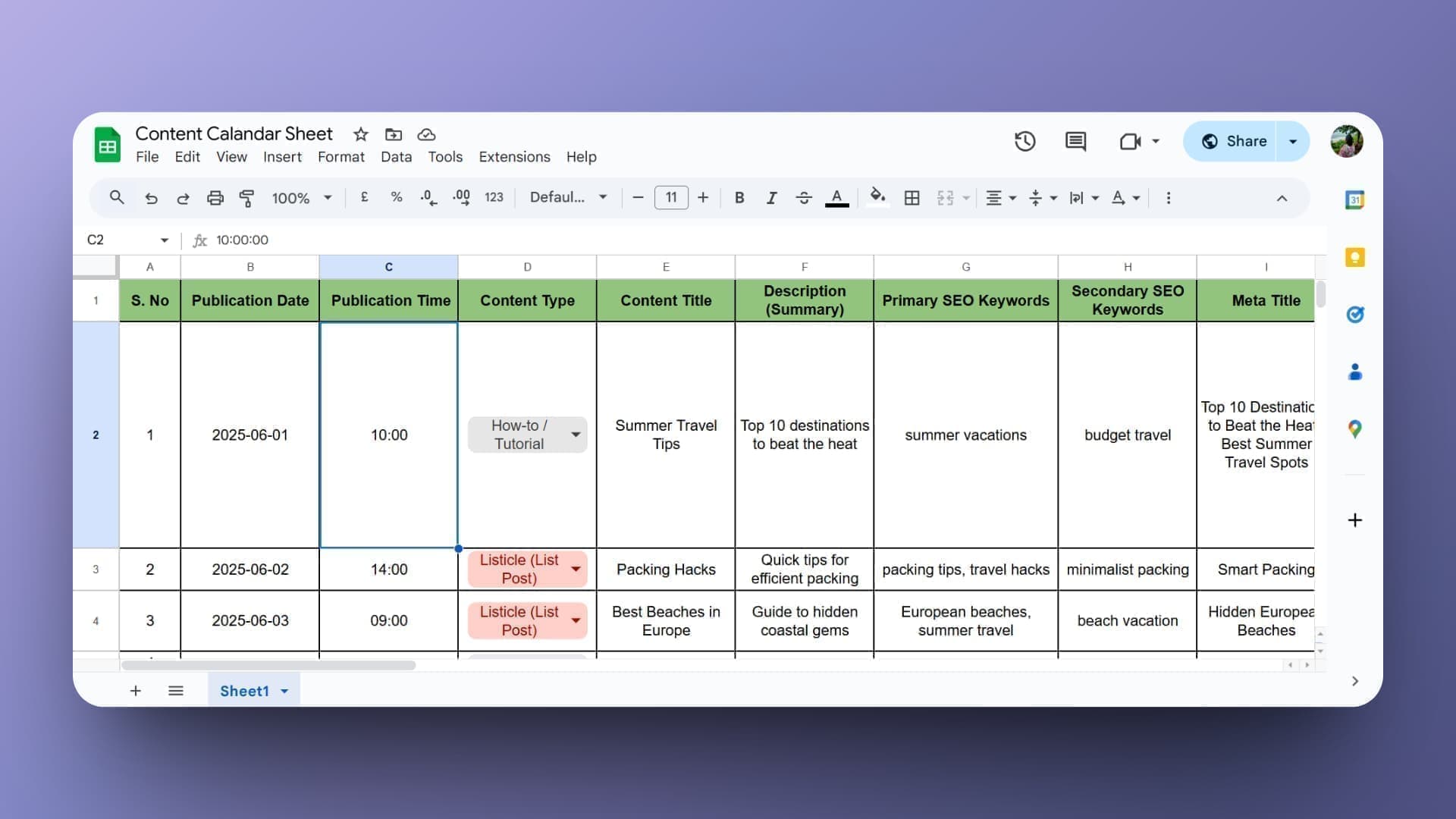
Source: Natiad
The Best AI Blog Writers with Content Calendar Features
The market is saturated with AI tools, but they fall into distinct categories. Choosing the right one is the difference between getting a list of ideas and putting your entire content marketing strategy on autopilot.
| Tool Type | Function | Key Limitation | Common Examples |
|---|---|---|---|
| Basic AI Blog Writer | Generates one article from a prompt. | Lacks strategic context, real-time SEO data, and planning features. Output is often generic. | ChatGPT, Jasper, Copy.ai |
| AI SEO Writing Assistant | Provides on-page optimization feedback on human-written text. | Requires you to write the content; it does not generate it. Acts as a spell-checker for SEO. | Surfer SEO, MarketMuse |
| AI Content Calendar Generator | Produces a list of blog topics based on a seed keyword, often in a spreadsheet. | Creates a to-do list but does not create the content. The plan is disconnected from execution. | Standalone "Topic Idea Generator" tools |
| End-to-End AI SEO Platform | Analyzes a site, builds a strategic roadmap, writes articles, and integrates with your CMS. | A complete system that acts as both planner and doer, automating the entire workflow. | Natiad, other full-cycle automation platforms |
While a basic writer is useful for ad-hoc tasks and an assistant can help a human writer optimize, only an end-to-end platform can truly automate the process from calendar generation to publication.
How to Create a 60-Day Content Calendar with AI: A Step-by-Step Guide
Step 1: Lay the Strategic Foundation
Before an AI can build your calendar, you must provide it with strategic direction. This foundational step involves defining your core content pillars, identifying your target audience, and setting measurable Key Performance Indicators (KPIs) for the 60-day period.
A successful automated content plan requires clear human-led goals. The quality of your input directly determines the quality of the AI's output.
- Define Your Core Content Pillars: These are 3-5 broad, foundational topics that your brand has authority in and that align with your products. For a project management SaaS, pillars might be "Agile Methodologies," "Team Collaboration," and "Productivity Software."
- Identify Your Target Audience and Search Intent: Define your ideal customer and map content to their journey (Top, Middle, and Bottom of Funnel). This ensures the AI generates topics that attract, engage, and convert.
- Set Measurable 60-Day KPIs: Establish specific, quantifiable goals. Instead of "increase traffic," aim to "Increase organic traffic to /blog by 20% in 60 days" or "Generate 50 new MQLs from blog content."
Step 2: Generate Your 60-Day Blog Topic Roadmap
To generate a 60-day blog topic roadmap, you provide an AI SEO platform with your strategic inputs like your domain and content pillars. The AI then analyzes SERPs, identifies content gaps, and produces a structured calendar of topic clusters.
This is where your strategy meets the AI's analytical power.
- Enter your website URL: The AI performs a content audit to understand what you've already covered and what's missing.
- Input your content pillars: This focuses the AI's research on the themes most important to your business.
- The AI generates topic clusters: The system groups semantically related keywords around your core pillars. This hub-and-spoke model is critical for demonstrating expertise to Google. For example, under the "Agile Methodologies" pillar, it might create a cluster with a pillar page on the main topic and spoke posts on "Kanban vs. Scrum" and "Sprint Retrospective Guide."
Step 3: Structure and Refine Your AI-Generated Calendar
Structuring your AI-generated calendar involves applying human oversight to prioritize topics based on business impact, mapping them to a publishing schedule, and adding essential tracking elements like funnel stage, keywords, and status.
The AI's raw output is a powerful draft. Your industry knowledge is crucial for refining it into a commercially intelligent plan.
- Review and Prioritize: Validate each topic against your business goals. Prioritize bottom-of-funnel content around product launches or high-impact topics that solve a major customer pain point.
- Map Topics to a Schedule: Choose a consistent publishing cadence (e.g., three times per week). Balance the funnel by mixing informational (ToFu), consideration (MoFu), and decision (BoFu) content throughout the week.
- Add Essential Calendar Elements: Use a spreadsheet or project management tool to track elements like Publish Date, Status, Primary Keyword, Funnel Stage, Target Persona, and CTA for each topic.
Free AI Content Calendar Templates
While an integrated platform is the ultimate goal, you can structure your AI's output in a powerful spreadsheet. This template incorporates the essential elements for an AI-driven workflow.
Simple 60-Day AI Content Calendar Template
Copy this markdown table and paste it into a spreadsheet application.
| Publish Date | Status | Topic/Title | Primary Keyword | Search Volume | Keyword Difficulty | Search Intent | Funnel Stage | Target Persona | Call-to-Action (CTA) | Assigned Agent/Writer | URL |
|---|---|---|---|---|---|---|---|---|---|---|---|
| 2024-10-20 | Ideation | ||||||||||
| 2024-10-22 | Ideation | ||||||||||
| 2024-10-24 | Ideation |
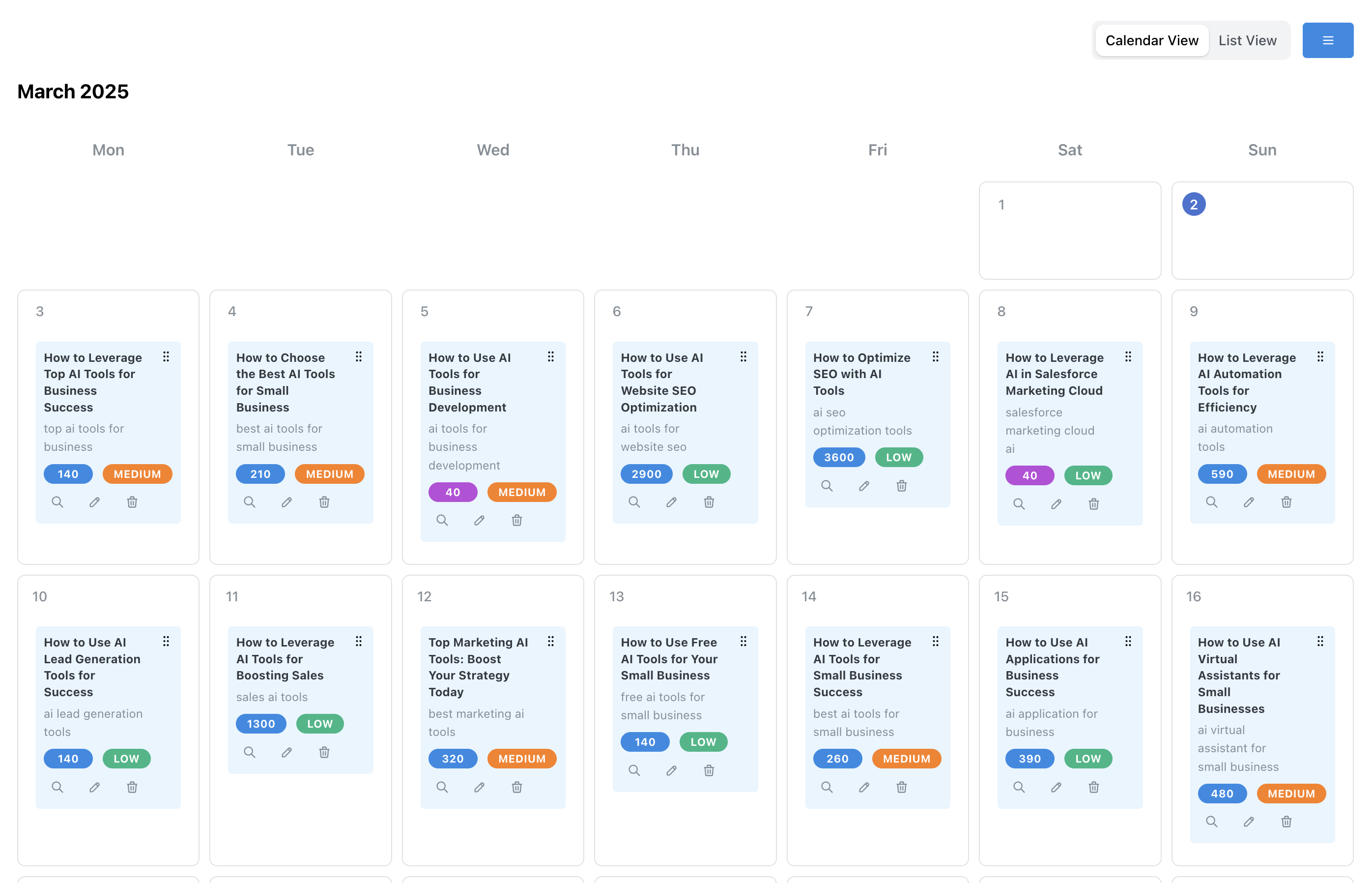
Source: emplibot.com
Step 4: Activate Automated Content Creation
Activating automated content creation involves using an integrated AI SEO platform to turn calendar topics into full article drafts with a single command. This connects the strategic plan directly to execution, eliminating the manual handoff to writers.
This is the core of the planner-and-doer model. Within the platform, you simply select a topic from your calendar and trigger the "Generate Article" function. The AI uses the title, keyword, and its real-time SERP analysis to create a full-length, structured blog post optimized for ranking.
Human Review is Still Essential: No AI draft should be published without human review. The goal is to automate 85% of the work, allowing your team to focus on the final 15%: checking factual accuracy, refining brand voice, and adding unique insights or proprietary data.
Step 5: Monitor Performance to Fuel the Next Cycle
Monitoring performance involves tracking KPIs like organic traffic, keyword rankings, and conversions for your published content. This data is then fed back into the AI platform to make the next 60-day planning cycle more intelligent and effective.
This creates a compounding advantage: your content strategy gets smarter over time. By connecting Google Analytics and Search Console to your AI platform, the system can automatically analyze performance, learn which topic clusters drive the most traffic and conversions, and use these insights to prioritize high-performing topics in future calendars.
Natiad is an AI SEO platform that puts a website's content marketing on autopilot using AI agents. It analyzes a site, creates a content roadmap, writes SEO-optimized articles, and automatically publishes them with internal links to drive traffic and revenue from search engines and AI assistants. Explore more at https://natiad.com.
Frequently Asked Questions (FAQ)
What is the best AI SEO writer for creating content calendars?
The best AI SEO writer is not just a tool for writing single articles but a comprehensive platform that integrates keyword research, strategic calendar planning, automated content creation, and performance analytics into a single, seamless workflow for maximum efficiency and impact.
What's the difference between a traditional content calendar and an AI one?
A traditional content calendar is a static planning document, like a spreadsheet, that requires manual input for ideas and tracking. An AI content calendar is a dynamic system that automates idea generation, strategic planning, and often content creation based on real-time data analysis.
Is AI-generated SEO content detectable?
While some tools can flag generic, low-quality AI writing, a high-quality AI SEO writer produces content that is structurally sound and contextually relevant. After a layer of human editing to add unique brand insights and a distinct voice, it becomes indistinguishable from and often superior to purely human-written content.
Can I get an AI content calendar tool for free?
Many free AI tools exist, but they are typically limited to generating a simple list of topic ideas. They lack the strategic capabilities like site analysis, keyword clustering, and automated content creation needed to build and execute a full content calendar designed for business growth.
How does an AI SEO writing assistant differ from an AI writer?
An AI SEO writing assistant primarily provides optimization suggestions and real-time feedback on human-written text. In contrast, an AI writer, particularly an AI blog writer platform, autonomously generates the entire article from a topic, performing the research and drafting functions itself.
How long does it take to create a 60-day calendar with AI?
Using an end-to-end AI SEO platform, you can generate the initial 60-day topic roadmap in under an hour. The time investment shifts from dozens of hours of manual research to a few hours of strategic review and refinement of the AI's output.
Building a 60-day content calendar is a powerful first step, but it reveals the next, larger bottleneck: execution at scale. A plan is only as valuable as your ability to consistently create, optimize, and publish the content it outlines. This is where a true automation platform becomes a strategic necessity. By connecting your data-driven calendar directly to an AI agent that handles the writing, internal linking, and publishing, you close the loop between strategy and execution. You move from simply planning the work to automating the outcome—consistent, high-quality SEO content that drives traffic and revenue on autopilot.