
Free AI Article Writers: A Marketer's Guide to When You Should (and Shouldn't) Use Them
When should you use a free AI article writer for SEO? Our marketer's guide covers the best use cases, top tools, and the critical human-in-the-loop workflow.
Free AI article writers promise a world of instant, SEO-optimized content with just a few clicks, but many marketers find the results fall flat, requiring more editing time than they save. Imagine spending an hour prompting a tool to generate a "perfect" blog post, only to receive a generic, repetitive article that sounds like a summary of the top five search results. You're left with a draft that needs to be completely rewritten to inject your brand's voice, expertise, and unique insights.
This common frustration highlights the core problem: using these tools without a proper framework often leads to generic, low-quality content that fails to rank and alienates readers. This guide provides a strategic, step-by-step process for leveraging free AI writers effectively—from identifying the right use cases and choosing the best tool for the job to implementing a quality-focused workflow that produces content ready for essential human refinement.
What is an AI SEO Writer and How Does It Work?
An AI SEO writer is a specialized tool that uses artificial intelligence to generate text based on user prompts, with built-in features specifically designed to help content rank in search engines. At their core, these tools are powered by Large Language Models (LLMs)—complex algorithms trained on massive datasets of text and code from the internet. Think of an LLM as a highly advanced predictive text engine; it analyzes a sequence of words (your prompt) and predicts the most statistically likely sequence of words to follow, creating coherent sentences, paragraphs, and entire articles.
The key differentiator between a general AI chatbot and a specialized AI SEO writer is its focus on ranking factors. While a general-purpose tool like ChatGPT can write an article if asked, a dedicated AI SEO writing assistant integrates SEO principles directly into its workflow. It goes beyond simple text generation to address specific needs for search visibility, covering many of the core SEO components needed to rank.
Many advanced AI SEO writing tools start by analyzing the current top-ranking pages (SERP analysis) for a target keyword. They identify common subheadings, frequently asked questions, semantic keywords, and the overall structure that Google is currently rewarding. This data-driven approach allows the AI to generate an outline and draft that aligns with proven ranking content, giving you a significant head start.
Step 1: When to Use a Free AI Article Writer for SEO (and When to Avoid It)
A free AI article writer for SEO should be used for low-risk, high-volume tasks like brainstorming, outlining, and drafting simple informational content. Conversely, it should be avoided for high-stakes content like YMYL topics, thought leadership, and core sales copy where trust and unique expertise are paramount.
Ideal Use Cases for Automated Content Creation
The best use cases for automated content creation involve supplementing, not replacing, the human content strategist. These tools are incredibly effective at overcoming the initial friction of the writing process.
- Brainstorming and Outlining: Use an AI writer to shatter writer’s block. Instead of one idea, you can generate five different angles for an article. For instance, prompt the tool with "suggest five unique angles for a blog post on 'content marketing for SaaS startups'."
- First Draft Generation (Zero Draft): For simple, top-of-funnel informational content (e.g., "what is a 401k," "how to tie a tie"), a free AI writer can create a foundational "zero draft." This shifts your effort from pure creation to the more valuable tasks of refinement and fact-checking.
- Creating Ancillary Content Snippets: AI is exceptionally efficient at generating short-form copy at scale. This includes drafting unique meta descriptions for a batch of blog posts, writing social media captions, or generating FAQ schema markup.
- Content Repurposing: Feed an AI a full transcript from a webinar and prompt it to: "Extract the 10 most important takeaways from this transcript and format them as a bulleted list." Then, follow up with: "Turn takeaway #3 into a 300-word LinkedIn post."

Source: Aitude
When You Should Not Use a Free AI Writer
AI-generated content is inappropriate for topics requiring deep expertise, unique perspective, or a high degree of trust and accuracy. Using AI in these contexts can damage your brand's credibility.
- YMYL (Your Money or Your Life) Content: Never use a free AI writer for topics in finance, health, medicine, and legal advice. These areas demand absolute accuracy and proven expertise from qualified professionals. AI models can "hallucinate" incorrect information with dangerous consequences.
- Thought Leadership and Opinion Pieces: Content that relies on your brand's unique perspective, novel arguments, or personal experiences is fundamentally human. AI models are trained on existing internet data, meaning their output is a sophisticated remix of what's already been said. They produce consensus, not contrarian viewpoints.
- In-depth Product Reviews and Case Studies: Authentic reviews and case studies require hands-on experience and specific data. AI can only generate generic descriptions based on existing information, which violates the spirit of Google’s product review guidelines.
- Core Sales and Landing Page Copy: Crafting persuasive, high-conversion copy demands a deep understanding of customer psychology and an emotional connection that is currently beyond the capabilities of AI content generators.
Step 2: The Pros and Cons of Using Free AI Writers for SEO
Before selecting a tool, it's crucial to have a balanced view of what free AI writers can and cannot do. They offer remarkable speed but come with significant trade-offs in quality and accuracy.
| Pros | Cons |
|---|---|
| Speed & Efficiency | Factual Inaccuracies (Hallucinations) |
| Drastically reduces time spent on first drafts and overcomes writer's block. | AI models can invent facts, stats, and sources, requiring rigorous verification. |
| Cost-Effective | Lacks Originality & Depth |
| Provides a free entry point to content creation without budget for writers. | Content is a remix of existing data, offering no unique insights or experiences. |
| Idea Generation | Generic, Robotic Voice |
| Excellent for brainstorming blog topics, headlines, and content angles. | The output often lacks brand personality and requires heavy editing to sound human. |
| Content Scalability | Poor at Complex or Nuanced Topics |
| Helps generate ancillary content like meta descriptions or social posts at scale. | Struggles with topics requiring deep expertise, analysis, or strategic thought. |
| Language & Tone Flexibility | Can Be Repetitive |
| Can easily rewrite content for different audiences or adjust the tone of voice. | Without careful prompting, AI can repeat phrases and ideas within the same article. |
Step 3: A Comparison of the Best Free AI Article Writers
The best free AI SEO writing assistant depends on your specific task. Some excel at long-form drafts, while others offer a suite of specialized micro-tools. Here’s a breakdown of the main categories and top contenders.
| Tool / Type | Best For | Key Free Features | Limitations of Free Plan |
|---|---|---|---|
| General AI Chatbots (e.g., ChatGPT, Gemini) | Brainstorming, outlining, and controlled section-by-section generation with detailed prompts. | Flexible, conversational interface. Can generate a wide variety of content types. | Requires skill in prompt engineering. Lacks built-in SEO guardrails or SERP analysis. Quality can be inconsistent. |
| All-in-One SEO Writers (e.g., SEOWriting.ai) | Generating a complete, SEO-focused first draft from a single keyword or topic. | Often includes SERP analysis, keyword suggestions, and a structured article-building process. | Free tiers have very restrictive word/article limits. Output can be generic and requires significant human refinement. |
| Modular Writing Assistants (e.g., Ahrefs' Tools) | Creating specific content pieces like outlines, meta descriptions, paragraphs, or headlines. | Provides a suite of free, targeted tools for different writing tasks. Simple to use for a single purpose. | The process is disjointed; you must manually assemble the pieces into a cohesive article. |
| AI Rewriters & Paraphrasers (e.g., QuillBot) | Rephrasing existing sentences or paragraphs for clarity, tone, or to avoid duplicate content. | Core paraphrasing and grammar-checking tools are often generously available for free. | Can lose original meaning or context. Not suitable for generating new ideas or full articles. |
What to Look For in a Free Plan
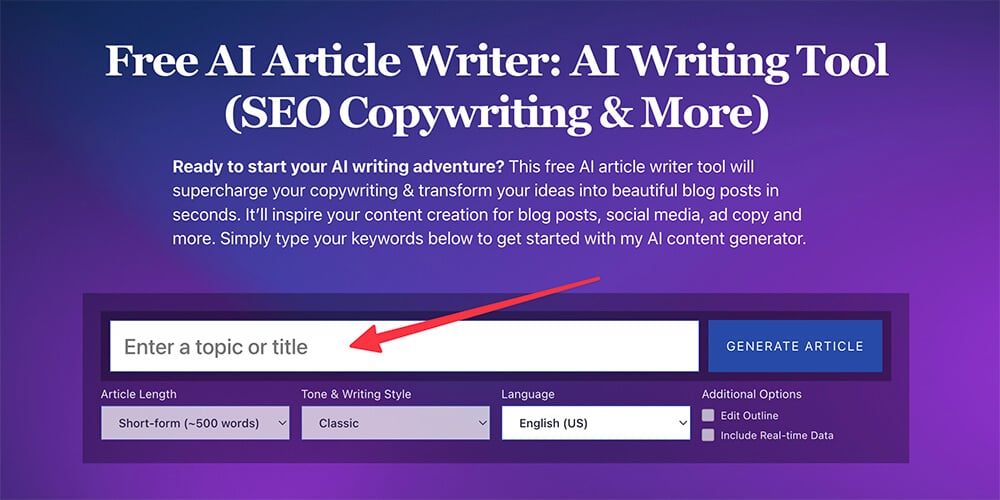
When evaluating a free AI tool, scrutinize the "free" offering to ensure it’s genuinely useful.
- Usage Limits: A limit of 1,000 words per month is barely a demo. Look for plans with 5,000-10,000 words or 2-3 articles per month to allow for meaningful work.
- Feature Access: Ensure the free plan includes core SEO functions like keyword input, tone selection, and an outline editor. If you can't specify a keyword, it's not a true SEO tool.
- Underlying AI Model: The quality of the LLM (e.g., GPT-3.5 vs. GPT-4) directly impacts the output. Newer models produce more nuanced and less repetitive text.
- Usability: A good tool should be intuitive. You're using it to save time, not to spend hours learning complex software.
Source: RyRob
Step 4: A 5-Part Workflow for AI SEO Writing
A successful AI-assisted content workflow involves a structured process that prioritizes human strategy and refinement over blind automation. This method treats the AI as an intern, not the final author.
Part 1: Strategic Prompting and Outline Refinement
The quality of your AI-generated content begins with a detailed, strategic prompt. Never start with a single keyword. Your initial prompt should act as a mini-creative brief.
Prompt Example: Role: Act as an expert SEO content strategist. Task: Create a detailed outline for a blog post on "AI chatbots for customer support." Audience: Customer support managers at mid-sized tech companies who are skeptical about AI. Key Concepts: 24/7 support, handling ticket volume, and freeing up human agents for complex issues. Tone: Professional, authoritative, but empathetic to their concerns.
Once the AI generates an outline, treat it as a suggestion. Critically review and edit it based on your own SERP analysis and understanding of user intent.
Part 2: Generate Content Section-by-Section
For superior quality and control, generate content for one heading at a time instead of using a "1-click article" feature. Feeding the AI one H2 from your refined outline provides a more focused context for each generation, preventing the AI from becoming repetitive or superficial.
Part 3: The Human-in-the-Loop Editing Process
All AI-generated text must pass through a rigorous human editing process focused on accuracy, brand alignment, and readability.
- Aggressive Fact-Checking: AI models are notorious for "hallucinating"—confidently inventing facts and statistics. Always verify every single claim against a reputable primary source before publishing.
- Brand Voice Injection: Rewrite sentences to match your brand's unique tone. Replace generic phrases with your company's specific terminology and viewpoint.
- Improving Readability and Flow: Read the entire article out loud. This is the best way to catch awkward, robotic phrasing. Break up long paragraphs and add bullet points.
Part 4: Enhancing with E-E-A-T (Experience, Expertise, Authoritativeness, Trust)
Elevate the AI draft by layering in human qualities that an AI cannot replicate, which are crucial for ranking.
- Add Authoritative Elements: Insert direct quotes from subject matter experts on your team. Link out to credible external studies or government data.
- Showcase Firsthand Experience: Weave in firsthand experiences or customer stories. Instead of "A way to do this is...", write "We tested three methods, and here's the one that delivered the best results..."
- Establish Trust: Ensure the article has a clear author byline that links to a detailed author profile showcasing their credentials and experience.
Part 5: Final On-Page SEO Polish
The final step is a manual on-page SEO check to ensure all elements are optimized for search visibility.
- Metadata: Write a compelling, click-worthy title tag (under 60 characters) and meta description (under 160 characters).
- Internal Linking: Manually add 2-3 relevant internal links to other authoritative pages on your website.
- Multimedia and Schema: Embed relevant images with descriptive alt text. If appropriate, add schema markup (like FAQPage) to enhance your SERP appearance.
Step 5: Creating Valuable, Human-First AI Content
Creating "undetectable" AI content is the wrong goal; the focus should be on producing high-quality, valuable content that search engines are designed to reward. The goal isn't to trick a detector but to delight a human reader.
The Myth of "AI Detection" and Google's Stance
AI detection tools are notoriously unreliable and are not a factor in how Google evaluates web content. Google has stated clearly that its systems reward original, high-quality content that demonstrates E-E-A-T, regardless of how it was created. Their policies target spammy, low-value content, not AI-assisted content. The emphasis is on the final product's value, not its origin.
How to Genuinely "Humanize" AI Content
- Add Unique Analysis and Opinion: Don't just state facts—interpret them. An AI can tell you what something is; a human expert can tell you what to do with it.
- Incorporate Specific, Non-Generic Examples: Replace vague AI suggestions with concrete, real-world examples from your own business or experience.
- Vary Sentence Structure and Rhythm: Manually edit the text to vary sentence length and structure. Mix short, punchy statements with more complex ones to create a natural, engaging flow.
- Tell a Story: Weave a brief narrative or personal anecdote into the introduction or to illustrate a complex point. Stories create an emotional connection and make the content more memorable.
Step 6: Knowing When to Graduate From Free AI Tools
Free AI writing tools are an excellent entry point, but they are not a scalable solution for a serious content marketing program. Recognizing when you've hit their limits is key to leveling up your strategy.
Signs You've Outgrown a Free AI SEO Blog Writer
- You spend more time heavily editing and fact-checking generic drafts than it would take to write them from scratch.
- Your content production is consistently bottlenecked by the daily or monthly word limits of your free plan.
- You require advanced features like team collaboration, custom brand voice libraries, and direct integration with your CMS.
- Your strategic focus is shifting from simply writing individual articles to building a comprehensive, data-driven content strategy.
What Paid AI SEO Platforms Offer
Paid AI SEO platforms move beyond simple text generation to offer strategic automation, higher-quality output, and deep workflow integration. They are designed to manage and scale an entire content marketing operation.
| Feature | Strategic Takeaway |
|---|---|
| Strategic Automation | Helps answer "what should we write about next to build topical authority?" and "is our content working?" |
| Higher Quality Output | Access to more advanced AI models produces more accurate first drafts that require significantly less editing. |
| Workflow Integration | One-click publishing to CMS, Google Search Console integration, and automated optimization scoring save time. |
| Scalability & Collaboration | Team accounts and brand voice libraries allow teams to scale production without sacrificing quality or consistency. |
Conclusion: Use Free AI Writers as a Co-Pilot, Not an Autopilot
Free AI article writers are powerful assistants for brainstorming, outlining, and creating initial drafts. They are an invaluable tool for overcoming inertia and speeding up the early stages of content creation. However, they fail when treated as a substitute for human strategy, domain expertise, and the critical editing process that builds trust.
By following the strategic workflow in this guide, you can harness the speed of AI while infusing your content with the quality and authenticity required to rank in search engines. This "co-pilot" approach ensures you maintain full control over your content. Once you have mastered this workflow and are ready to scale, the logical next step is to implement a paid AI SEO platform that automates the entire process you've perfected, truly putting your content marketing on a growth trajectory.
Natiad is an AI SEO platform that puts a website's content marketing on autopilot using AI agents. It analyzes a site, creates a content roadmap, writes SEO-optimized articles, and automatically publishes them with internal links to drive traffic and revenue from search engines and AI assistants. Explore more at https://natiad.com.
Frequently Asked Questions (FAQ)
What is the best free AI article writer for SEO?
There is no single "best" free AI tool; the ideal choice depends on your specific task. For flexible brainstorming and controlled generation, ChatGPT's free version is powerful. For generating a quick, structured first draft, a tool with a free tier like SEOWriting.ai is a good starting point. For creating ancillary content like meta descriptions, a suite of modular tools like those from Ahrefs is effective.
Can AI write a full SEO-friendly blog post?
Yes, an AI can write a full blog post, but it requires significant human intervention to be truly "SEO-friendly" and high-quality. A raw AI draft is rarely ready to publish. It needs rigorous fact-checking, heavy editing for brand voice, the addition of unique insights or data (E-E-A-T), and a final manual on-page optimization check.
Will Google penalize me for using an AI SEO content writer?
No, Google will not penalize you simply for using an AI writer. Google's official stance is that they reward high-quality, helpful content regardless of how it is produced. Their spam policies target low-quality content created to manipulate search rankings. Unedited, generic AI output can easily fall into this category, so the focus must remain on creating value for the reader.
How do I use an AI blog writer for free?
You can use an AI blog writer for free by signing up for the "freemium" plans offered by many platforms. Services often provide a set number of words or credits per month. This allows you to test their features and draft a few articles without a paid subscription, making it a great way to evaluate which tool best fits your needs.
What are the main limitations of a free AI SEO article writer?
The primary limitations are restrictive usage caps (word/article counts), limited access to advanced SEO features (like real-time SERP data), and often the use of less powerful AI models. They also lack the team collaboration and workflow automation features needed to efficiently scale content production.