
The Top 5 AI Tools for Automating SEO Content Workflows
Discover the best AI tools for SEO content writing to automate your workflow. We review the top 5 platforms like Surfer SEO and Jasper for SERP analysis and speed.
The best AI tools for SEO content creation are those that integrate real-time SERP analysis, NLP-driven keyword suggestions, and on-page optimization guidance directly into the writing process. Top-tier platforms like Surfer SEO, Jasper, and Writesonic excel by automating the most time-consuming parts of the SEO content workflow. This enables marketing teams and creators to produce high-ranking content with greater speed, consistency, and data-backed confidence than is possible with simple text generators alone.
These advanced tools represent a fundamental shift away from first-generation AI writers, which were often little more than simple wrappers for language models like GPT. Instead of just generating text from a prompt, a true AI SEO writer tool provides a strategic framework for creating articles engineered to meet the specific criteria search engines use to rank content.
They systematically analyze top competitors for a given keyword, identify the critical topics and semantic terms that must be included, and provide a live scoring system to guide your writing toward a competitively optimized state. This data-driven approach removes the guesswork from on-page SEO. It allows content creators, from solo bloggers to large marketing departments, to focus on adding value, unique insights, and brand voice to a structure that is already primed to perform. The primary goal is to streamline the entire content pipeline—from initial research and briefing to drafting, editing, and final publication.
Why Use a Dedicated AI Tool for SEO Content?
While general AI chatbots like ChatGPT can generate text, they lack the specialized features needed for competitive SEO. A dedicated AI SEO tool provides a distinct advantage by building the entire writing experience around data pulled directly from search engine results pages.
Here’s why they are more effective:
- Live SERP Data: They analyze the current top-ranking pages to understand what Google is rewarding for a specific keyword, providing data-driven recommendations on topics, questions, and keywords to include.
- On-Page Optimization: They offer real-time content scoring and checklists directly within the editor, guiding you to create a comprehensive, well-optimized article that covers a topic better than your competitors.
- Structured Workflows: They are designed to support a complete content workflow, from research and automated briefing to drafting and publishing, saving countless hours of manual work.
- Topical Authority Focus: Many include features for keyword clustering and internal link suggestions, helping you build a network of related content that establishes your site as an authority in its niche.
How We Tested and Ranked These AI SEO Writing Tools
We evaluated each platform on its ability to support an end-to-end SEO content workflow, the depth and accuracy of its SEO features, and the overall quality and control of its AI-generated output. Our ranking methodology prioritizes tools that deliver a significant return on investment by saving hundreds of hours and measurably improving search performance. We focused on platforms that move beyond simple automated content creation to offer true strategic workflow automation.
To identify the absolute best tools for putting SEO content on autopilot, we established a rigorous set of criteria. This wasn't about which AI could generate the most words the fastest; it was about which platforms provide the actionable intelligence and seamless user experience needed to consistently rank in competitive SERPs.
Here’s the detailed breakdown of our evaluation process:
- End-to-End Workflow Integration: We assessed how well each tool connects the critical stages of content creation. The ideal platform minimizes the need to juggle multiple subscriptions for keyword research, SERP analysis, content briefing, AI drafting, and on-page optimization.
- SEO Feature Depth & Accuracy: This was a core component of our testing. We tested the precision of each tool's SERP analysis, evaluating its ability to identify key entities, common questions, and relevant NLP terms. Features like automated internal linking and content decay audits were given significant weight.
- AI Output Quality & User Control: We generated multiple articles to assess readability, coherence, and factual accuracy. Beyond just the raw output, we evaluated the level of user control. Can you define a brand voice or upload a style guide? The best tools act as a collaborative partner.
- User Experience (UX) and Learning Curve: A powerful tool is useless if it's too complicated. We considered the onboarding process, the clarity of the interface, and the overall learning curve for a new user.
- Integrations and Publishing: An AI SEO writing assistant must fit into an existing tech stack. We prioritized platforms with robust integrations for Google Docs, WordPress, and popular SEO suites.
- Overall Value and Pricing: Finally, we weighed the pricing tiers against the complete feature set and usage limits. The best tools are not necessarily the cheapest; they are the ones that provide the most significant potential ROI.
1. Surfer SEO: Best for Data-Driven Content Briefs and Optimization
Surfer SEO is a premier content intelligence platform that transforms real-time SERP analysis into highly actionable content briefs and an interactive editor for meticulous on-page optimization. It is the industry standard for SEO professionals and content teams who demand a data-backed process to ensure every article is structured to outrank top competitors.
If your content strategy is built on data, not guesswork, Surfer is the foundational tool. It deconstructs the top-ranking pages for your target keyword and provides a precise, reverse-engineered blueprint for success. It tells you which semantic terms to use, the ideal word count, the optimal number of headings and images, and more.
At its core, Surfer provides a Content Editor that scores your article in real-time against its SERP analysis. This live feedback loop is incredibly powerful for training writers on SEO best practices and ensuring brand-wide consistency. For teams managing freelance writers, this feature is invaluable for quality control.
| Tool | Detail | Takeaway |
|---|---|---|
| Surfer SEO | Content Editor | Provides a real-time content score based on NLP terms, structure, and readability. |
| Surfer SEO | Automated Briefs | Generates comprehensive, shareable content briefs from SERP data. |
| Surfer SEO | Integrations | Offers best-in-class integration with Google Docs, WordPress, and Jasper. |
| Surfer SEO | Content Audit | Analyzes existing URLs against current SERPs and provides a checklist of refresh recommendations. |
An Example Surfer Workflow
- Enter Keyword: You start by entering your primary target keyword into the Content Editor or Audit tool.
- Customize SERP Analysis: Surfer pulls the top results. You can deselect irrelevant competitors (like forums or e-commerce pages) to refine the data.
- Generate Brief: With one click, Surfer creates a detailed brief containing competitor outlines, user questions, and a full list of NLP terms.
- Write and Optimize: You can write directly in Surfer's editor or use the Google Docs extension. As you write, the sidebar updates your content score in real-time.
- Publish: Once your score is in the target range (typically 70+), you can export the HTML or copy it into your CMS.
Key Features for SEO Workflows:
- Content Editor: The platform's crown jewel. It gives you a live score as you write, based on hundreds of on-page factors pulled from top-ranking pages.
- Automated Content Briefs: In minutes, Surfer generates a detailed brief that can be shared with writers, including word counts, heading structures, "People Also Ask" questions, and semantic terms.
- Keyword Research: The platform includes a robust tool for finding related keywords and grouping them into topic clusters, essential for building topical authority.
- Content Audit: Plug in an existing URL, and Surfer will analyze it against current top competitors, giving you a prioritized list of quick wins to improve its ranking.
Pros:
- Unmatched, data-driven guidance for on-page SEO. The NLP algorithm is best-in-class.
- Excellent integrations with Google Docs, WordPress, and Jasper make it easy to adopt into any workflow.
- The "Grow Flow" feature delivers weekly, AI-driven tasks for improving your site's overall SEO.
Cons:
- The built-in AI writer (Surfer AI) is a separate, additional cost per article, which can make the all-in-one platform pricey.
- The sheer amount of data can be overwhelming for absolute beginners.
2. Jasper: Best for High-Quality AI Copywriting at Scale
Jasper is a premium AI writing platform renowned for generating highly engaging, human-like copy and offering a vast library of marketing-focused templates. Its direct integration of Surfer SEO's technology makes it a formidable hybrid tool for producing top-quality, fully optimized long-form content at scale.
If Surfer is the meticulous SEO analyst, Jasper is the master copywriter. The quality of the prose it generates is consistently a step above many competitors, excelling at capturing a specific tone of voice and producing creative, persuasive text that avoids feeling robotic. This makes it ideal not just for AI SEO blog writer tasks, but also for ad copy, social media campaigns, and email newsletters.
The "Boss Mode" feature unlocks its power for long-form content. Instead of being confined to templates, you can issue direct, natural language commands within the editor, such as "Write a paragraph about the benefits of a work-life balance for remote employees," creating a flexible and collaborative writing experience.
| Tool | Detail | Takeaway |
|---|---|---|
| Jasper | Boss Mode | A long-form editor that lets you control the AI with natural language commands and recipes. |
| Jasper | SEO Mode | Directly integrates Surfer SEO's entire optimization toolkit into the Jasper interface. |
| Jasper | Content Templates | Provides dozens of pre-built templates for specific tasks like meta descriptions or AIDA frameworks. |
| Jasper | Brand Voice & Memory | Can be trained on your style guides and existing content to maintain brand consistency. |
An Example Jasper Workflow
- Choose a Template or Start in Boss Mode: Start with a template like the "Blog Post Workflow" or an open document.
- Activate SEO Mode: Toggle on SEO Mode and input your target keyword. Jasper connects to Surfer's API to run a SERP analysis.
- Draft with Commands: Using natural language, you instruct Jasper to write an intro, create an outline, and then flesh out each section.
- Optimize in Real-Time: As you draft, the integrated Surfer sidebar tracks your content score and highlights the keywords you need to include.
- Refine and Polish: Use Jasper's built-in rephrasing and grammar tools to polish the final draft.
Key Features for SEO Workflows:
- Boss Mode: The flagship long-form editor that enables a fluid, command-driven writing process adaptable for creating entire blog posts.
- SEO Mode: A native integration with Surfer SEO that overlays the complete optimization panel inside the Jasper editor for a unified workflow.
- Content Templates & Recipes: A huge library of templates for specific marketing outputs. "Recipes" are user-generated workflows of repeatable commands that can be saved and shared.
- Brand Voice & Knowledge Base: You can upload documents, URLs, and style guides to train Jasper on your specific brand identity, product details, and audience.
Pros:
- Generates some of the most natural, persuasive, and stylistically nuanced copy of any AI writer.
- Incredibly versatile, capable of handling everything from 3,000-word SEO articles to short-form social media posts.
- Backed by an active user community and a wealth of official training resources.
Cons:
- It's a premium tool, and the pricing, based on word credits, can be a significant investment.
- The best SEO features require a separate, active Surfer SEO subscription, effectively doubling the cost for that functionality.
3. Writesonic: Best for Rapid, Full-Article Generation
Writesonic is an all-in-one AI content platform engineered for speed and efficiency, offering tools that can generate a complete, SEO-optimized first draft of an article in just a few minutes. Its flagship feature, AI Article Writer 6.0, leverages real-time SERP data to produce factually relevant long-form content that significantly reduces editing time.
Think of Writesonic as the efficiency engine of your content team. Its primary strength is its ability to go from a simple topic idea to a 1,500-word article draft with minimal input. For content teams under pressure to produce a high volume of quality content quickly, this is a game-changer.
The platform is more than a one-trick pony, offering a comprehensive suite of features including an AI-powered editor (Sonic Editor), a chatbot builder (Botsonic), and direct integrations with leading SEO tools like Semrush. This makes it a surprisingly powerful and versatile option for agencies and affiliate marketers.
| Tool | Detail | Takeaway |
|---|---|---|
| Writesonic | AI Article Writer 6.0 | A guided, multi-step workflow that produces full-length, SEO-friendly articles from one prompt. |
| Writesonic | Semrush Integration | Pulls keyword data and SERP insights directly from Semrush to inform content creation. |
| Writesonic | Botsonic | A no-code AI chatbot builder that can be trained on your website's content and documents. |
| Writesonic | API Access | Allows for programmatic content creation, ideal for generating product descriptions at scale. |
An Example Writesonic Workflow
- Select AI Article Writer 6.0: Choose this feature from the library.
- Input Your Topic and Keywords: Provide your main topic. You can add supplementary keywords and connect your Semrush account for better data.
- Select Top-Ranking References: The tool pulls top-ranking articles from Google. You select the ones you want the AI to use as a reference.
- Generate and Customize the Outline: Writesonic proposes a detailed outline. You can easily edit, reorder, or add new sections.
- Generate the Full Article: With a final click, the AI writes the complete article based on your inputs.
Key Features for SEO Workflows:
- AI Article Writer: A step-by-step process that guides you from title generation to a complete blog post, using real-time SERP data and reference articles.
- Sonic Editor: A Google Docs-style editor that incorporates AI writing tools, including a rephraser, expander, summarizer, and an integrated SEO checker.
- Botsonic AI Chatbot Builder: A unique feature that lets you create a custom GPT-4 powered chatbot trained on your sitemap and knowledge base.
- API Access: For technical teams, the API unlocks the ability to build content creation directly into their own applications, perfect for e-commerce or programmatic SEO.
Pros:
- Extremely fast at generating solid, well-structured first drafts of long-form articles.
- Direct integration with Semrush brings high-quality keyword and competitor data into the writing process.
- Offers one of the most generous free trials and is generally more affordable than similar all-in-one platforms.
Cons:
- The raw output can sometimes lack the stylistic polish of Jasper and may require more human editing to inject brand personality.
- The user interface is packed with features, which can feel cluttered for new users.
4. Frase: Best for AI-Powered Research and Content Briefing
Frase is an AI-powered tool that automates the most time-consuming part of SEO content creation: research and briefing. It meticulously analyzes top search results for any keyword and instantly generates a detailed content brief, making it indispensable for strategists who need to deeply understand search intent before writing.
Frase's superpower is research automation. It reads, analyzes, and summarizes the entire first page of Google for you, extracting headings, common questions, statistics, and key topics from your competitors into a comprehensive, interactive brief. A process that used to take hours can now be completed in seconds.
This makes Frase the perfect starting point for any serious content piece. It ensures your writers are armed with all the necessary information to create a comprehensive article that covers the topic better than the current top-ranking results.
| Tool | Detail | Takeaway |
|---|---|---|
| Frase | Automated Content Briefs | Analyzes SERP results to create briefs with outlines, topics, questions, and external links. |
| Frase | Content Editor | Scores your content in real-time against top-ranking competitors based on topic coverage. |
| Frase | Outline Builder | A drag-and-drop interface that lets you build an outline using headings from top-ranking articles. |
| Frase | GSC Integration | Connects to Google Search Console to find content decay and new optimization opportunities. |
An Example Frase Workflow
- Create a New Document: Input your target search query. Frase immediately analyzes the top 20 results.
- Review the Content Brief: The automated brief is generated. You review competitor outlines, SERP-sourced questions, and key topics.
- Build Your Outline: Use the drag-and-drop Outline Builder to pull headings and ideas from competitor articles.
- Write and Optimize: Write in the Frase editor. The "Topic Score" panel on the right updates in real-time, showing how your content compares to competitors.
- Identify Opportunities: Connect your Google Search Console account, and Frase will identify pages with declining traffic that are perfect candidates for an update.
Key Features for SEO Workflows:
- Automated Content Briefs: The core feature. It breaks down the top search results into an actionable brief, highlighting competitor outlines, word counts, and questions from across the web.
- Content Editor & Topic Score: A real-time editor that scores your content based on topic coverage against the competition, providing suggestions to help you create a more comprehensive piece.
- AI Writer: Frase includes a suite of AI writing tools for generating paragraphs, rewriting sentences, and automatically answering sourced questions.
- Google Search Console Integration: This powerful feature allows Frase to analyze your site's performance data, flagging pages with declining traffic and suggesting new keywords to target.
Pros:
- Unbeatable speed and depth for content research and brief generation.
- Excellent for deeply understanding and aligning with search intent before writing begins.
- The Google Search Console integration provides a proactive way to maintain and improve existing content rankings.
Cons:
- The AI-generated text is generally not as high-quality as that from dedicated writers like Jasper.
- Its topic recommendations are based on TF-IDF analysis, which can be less precise than the more advanced NLP models used by tools like Surfer SEO.
5. All In One SEO (AIOSEO): Best for AI SEO Workflows Inside WordPress
All In One SEO (AIOSEO) is a top-tier WordPress SEO plugin that integrates a powerful AI writing assistant, TruSEO, directly into the native WordPress editor. It is the ultimate solution for creators and businesses who manage their content within WordPress, as it consolidates research, writing, optimization, and internal linking into a single, unified workflow.
If your website runs on WordPress, the primary advantage of AIOSEO is unparalleled convenience. You never have to leave your website's backend. The AI SEO writing assistant lives right inside the editor you're already using.
The internal linking feature, Link Assistant, is another massive benefit. It automatically scans all your published content and suggests relevant internal links to add to your new post. This is a tedious but critically important SEO task that AIOSEO automates beautifully, helping you build strong topic clusters and improve how search engines crawl your site.
| Tool | Detail | Takeaway |
|---|---|---|
| AIOSEO | TruSEO AI Assistant | A prompt-based AI writer built directly into the WordPress block editor for seamless content creation. |
| AIOSEO | TruSEO Analysis | A real-time on-page SEO checklist and scoring system that guides optimization within the editor. |
| AIOSEO | AI Title/Meta Generator | Creates multiple optimized title and meta description options with one click, based on content analysis. |
| AIOSEO | Link Assistant | Scans your entire site and provides relevant internal linking suggestions automatically as you write. |
An Example AIOSEO Workflow
- Create a New Post in WordPress: Start a new post or page as you normally would.
- Use AI to Generate Titles/Metas: Enter your focus keyphrase in the AIOSEO settings and click the "Generate AI Title/Description" button to get several optimized options.
- Draft Content with the AI Assistant: Within the editor, use the AIOSEO AI tools to generate a full outline. Then, instruct the AI to write an introduction or expand on a specific heading.
- Optimize with TruSEO: As you write, the TruSEO score updates. Follow the actionable checklist to improve your score, addressing everything from keyword density to readability.
- Add Internal Links: Open the Link Assistant tab. AIOSEO will display a list of relevant existing posts. With one click, you can add those links to your new article.
Key Features for SEO Workflows:
- TruSEO AI Assistant: Generate headlines, meta descriptions, outlines, or entire articles without ever leaving the WordPress editor.
- TruSEO On-Page Analysis: Get a real-time score and an actionable checklist that covers all key on-page SEO factors.
- AI Title/Meta Description Generator: Instantly create compelling, SEO-friendly titles and meta descriptions based on your post's content.
- Link Assistant: A powerful tool that automates the internal linking process by suggesting relevant linking opportunities directly in the editor.
Pros:
- Perfectly and seamlessly integrated into the native WordPress user experience.
- Combines a capable AI writer with a complete suite of on-page, technical, and local SEO tools in one plugin.
- The Link Assistant feature is a massive time-saver and a powerful tool for building site authority.
Cons:
- It is exclusively for WordPress users, so it's not an option for sites built on other platforms.
- The AI writer is convenient but may not have the advanced long-form capabilities of a standalone platform like Jasper.
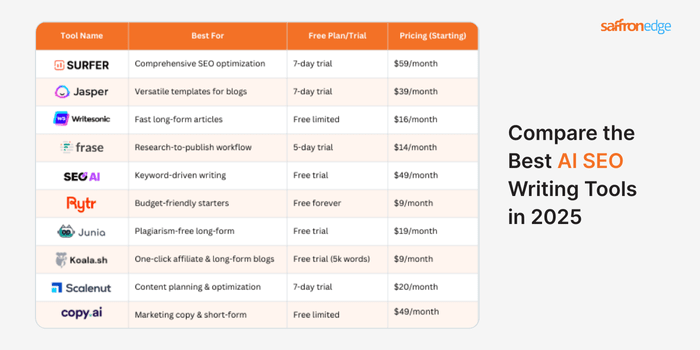
Comparison Table: Top AI SEO Writing Tools at a Glance
Source: Natiad
| Tool | Best For | Core Function | Starting Price (Annual) | Free Plan/Trial | Key Integration |
|---|---|---|---|---|---|
| Surfer SEO | On-Page Optimization | Data-driven editor & briefer | ~$99/mo | No | Google Docs, WordPress, Jasper |
| Jasper | High-Quality Copy | Creative AI copywriter | ~$39/mo | Yes, 7-day trial | Surfer SEO, Grammarly |
| Writesonic | Rapid Article Generation | 1-click article generator | ~$16/mo | Yes, generous free plan | Semrush, WordPress |
| Frase | Research & Briefing | Research automation | ~$45/mo | Yes, free plan/trial | Google Search Console |
| AIOSEO | WordPress Integration | All-in-one WordPress plugin | ~$49.60/yr | No | Native WordPress |
Buyer's Guide: Key Features to Look For in an AI SEO Writer
Choosing the right AI SEO writer can feel overwhelming. To cut through the noise, focus on the core features that directly impact content performance and workflow efficiency.
1. Real-Time SERP Analysis
This is the most critical feature. The platform must be able to analyze the current top-ranking pages for your target keyword in real-time. This analysis should form the basis for all its recommendations. Without live SERP data, the AI is just guessing what Google wants to see.
2. Automated Content Briefing
A great tool should automate the research process by generating a comprehensive content brief. Look for briefs that include competitor outlines, questions to answer (from "People Also Ask," etc.), key topics/NLP terms, and recommended word counts.
3. In-Editor Content Scoring
A real-time content score provides an immediate feedback loop that is essential for effective optimization. As you write, the score should update, showing you how closely your content aligns with the data-driven targets.
4. High-Quality AI Text Generation
Assess the quality of the generated text. Does it sound natural? Is it factually accurate? Does it require heavy editing? Look for tools that allow you to set a brand voice and provide background information to steer the AI with precision.
5. Seamless Workflow Integrations
The tool should fit into your existing content process. Key integrations to look for include a WordPress plugin, a Google Docs add-on, and a built-in plagiarism checker.
6. Features for Building Topical Authority
Modern SEO is about building authority around topics. Look for features that support this, such as keyword clustering tools and automated internal linking suggestions.
What About Free AI SEO Tools like ChatGPT?
While free tools like ChatGPT and Google Gemini are incredibly powerful language models, they are not specialized SEO content tools. They function like a brilliant writer in a dark room—they can write eloquently about a topic, but they have no visibility into the competitive landscape of the SERPs.

Source: Natiad
- Pros: Excellent for brainstorming ideas, creating initial drafts, and overcoming writer's block at no cost.
- Cons: They cannot analyze live SERP data, provide NLP keyword suggestions, score your content against competitors, or generate data-driven content briefs.
For serious SEO, using a general chatbot requires a separate, manual research process. You would need another tool to analyze competitors and then feed that information back into the chatbot via complex prompts. A dedicated tool like Surfer or Frase automates this entire process, making it far more efficient and effective.
Natiad is an AI SEO platform that puts a website's content marketing on autopilot using AI agents. It analyzes a site, creates a content roadmap, writes SEO-optimized articles, and automatically publishes them with internal links to drive traffic and revenue from search engines and AI assistants. Explore more at https://natiad.com.
Frequently Asked Questions About AI Content and SEO
Can AI-generated content actually rank on Google?
Yes, absolutely. Google's official guidance is that they reward high-quality, helpful content that satisfies search intent, regardless of how it was produced. The focus is on the quality of the final product, not the tools used. An AI-assisted article that is comprehensive, accurate, and well-structured can and does outrank human-written content that fails to meet those standards.
Will I get penalized by Google for using AI content tools?
No, you will not be penalized for simply using AI to assist in your content creation. Google's policies penalize spammy, low-quality content designed to manipulate search rankings, not the use of AI itself. The key is to ensure a human is always in the loop to edit, fact-check, and add unique value and experience (the "E" in E-E-A-T).
How much human editing does AI-generated content require?
This depends on the quality of the tool and the complexity of the topic. A top-tier tool might produce a draft that is 80-90% complete, requiring only fact-checking, brand voice adjustments, and the addition of personal anecdotes. For more technical subjects, expect to do more significant editing. A good rule of thumb is to treat the AI output as a high-quality first draft from a junior writer.
What is the difference between an AI writer and an AI SEO tool?
An AI writer (like a basic ChatGPT interface) generates text based on a prompt. An AI SEO tool (like Surfer SEO or Frase) analyzes search engine results pages to provide data-driven guidance on how to structure and write content that will rank. The former creates words; the latter provides the strategic blueprint for which words to use and how to use them for maximum SEO impact.
Is an undetectable AI SEO writer better?
The concept of an "undetectable AI writer" is largely a marketing gimmick that focuses on the wrong metric. Google is far more interested in content quality and helpfulness than in its origin. A much more sustainable strategy is to use AI to produce a solid foundation and then have a human editor enhance it with real expertise, unique insights, and a compelling narrative.
Final Verdict: Choosing the Right AI SEO Tool for Your Workflow
The tools on this list represent the best options on the market, but the right choice depends entirely on your specific needs, workflow, and budget.
- For data-obsessed SEOs and agencies: Surfer SEO is the non-negotiable choice for its best-in-class SERP analysis and content optimization editor.
- For marketers who prioritize copy quality and versatility: Jasper generates the most human-like text and excels at a wide range of marketing tasks beyond just blog posts.
- For high-volume publishers who need speed: Writesonic is the fastest path from a keyword to a complete, well-researched first draft.
- For content strategists focused on research: Frase automates the research and briefing process better than any other tool, ensuring every article is built on a comprehensive foundation.
- For WordPress users seeking convenience: AIOSEO provides a powerful, all-in-one solution without ever needing to leave your website's dashboard.
These tools are powerful components, but true competitive advantage comes from automating the entire content strategy, not just individual tasks. While they are exceptional for optimizing a single article, they still require you to perform the keyword research, build the content calendar, and manage the overarching strategy.
This is where the conversation shifts from using AI tools to deploying an AI-driven system. The next evolution is removing that strategic bottleneck entirely. Imagine a platform where AI agents don't just write an article but analyze your entire site and competitive landscape to create a complete, data-driven content roadmap—identifying opportunities, generating clusters of articles, and publishing them with perfect internal links to build your authority on autopilot.
The tools on this list are the best in their class for crafting and optimizing individual pieces of content. But when you’re ready to deploy a cohesive, automated content engine, the next logical step is a platform built for that purpose.